Agrippan Trilemma: Theoretical Impossibility of Proving Truths
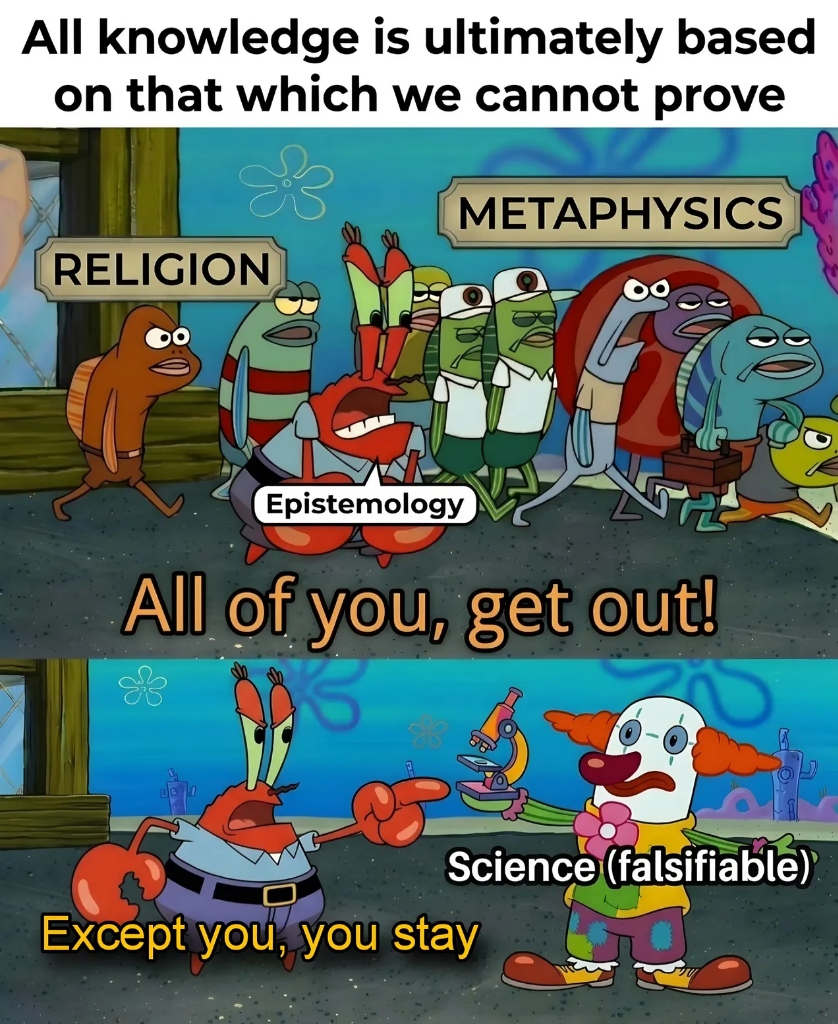
Can any substantive proposition about reality be proven with absolute, unassailable certainty?
In formal epistemology, this question runs headfirst into an ancient structural barrier known as the Agrippan Trilemma (attributed by Sextus Empiricus to the Pyrrhonian skeptic Agrippa, and reformulated in the twentieth century by Hans Albert as the Münchhausen Trilemma). The trilemma begins with a deceptively simple demand: if you claim to know a proposition $P$, you must offer a justification $J_1$ supporting $P$. Yet $J_1$ is itself a claim, and if $J_1$ is asserted without justification, why should anyone accept $P$ on its basis?
Once you demand a justification for every justification, every possible chain of reasoning is forced into one of three structural dead ends:
- Infinite Regress (Infinitism): $P$ is justified by $J_1$, which is justified by $J_2$, which is justified by $J_3$, continuing without end ($P \leftarrow J_1 \leftarrow J_2 \leftarrow \cdots$). Because human minds are finite, an unending chain never supplies a completed proof.
- Circular Reasoning (Coherentism / Diallelus): The chain of justification eventually loops back onto a premise that already appeared earlier in the argument ($P \leftarrow J_1 \leftarrow \cdots \leftarrow P$). While a mutually supporting web of beliefs may be internally consistent, consistency alone cannot distinguish a coherent truth from a coherent fiction.
- Dogmatic Halting (Foundationalism / Hypothesis): The chain is terminated at some foundational premise $A_0$ declared to be "self-evident," "axiomatic," or beyond question. Even in pure mathematics, deductive proofs only establish conditional truth ($A_0 \implies P$); the unconditional truth of $P$ remains only as secure as the unproved starting axiom $A_0$.
Metaphysics, Dogma, and the Temptation of Final Foundations
Throughout intellectual history, traditional theological and rationalist metaphysical systems have tried to escape Agrippa's net, only to illustrate its third horn. Dogmatic theology halts the regress explicitly by appealing to an infallible authority (a sacred text, revelation, or necessary first cause) whose authority cannot be questioned within the system. Classical rationalist metaphysics attempts a subtler route: deriving the structure of the world from "self-evident" intuitions of pure reason. Yet history repeatedly shows that what one century regards as an indubitable intuition (Euclidean parallel postulates, absolute simultaneity, unrestricted set comprehension), a later century discovers to be a contingent assumption that fails in broader domains.
What about the natural sciences? If we judge empirical science by the classical standard of infallible verification, science does not escape the Agrippan Trilemma either. Every laboratory inference relies on background assumptions: the uniformity of nature across space and time, the calibration of instruments, and the problem of induction identified by David Hume: no finite number of observed white swans ($N$) can deductively entail the universal law that all swans are white ($\forall x\, S(x) \implies W(x)$).
Karl Popper, Falsifiability, and Critical Rationalism
Why, then, does empirical science succeed so powerfully where dogmatic systems stagnate? In The Logic of Scientific Discovery (1934), philosopher Karl Popper proposed a radical shift in epistemological strategy: stop trying to prove theories true, and instead design theories so that reality can prove them false.
Popper noticed a fundamental logical asymmetry between verification and falsification:
- Verification is inductively open-ended: Million of confirming instances of a universal law $T \implies O$ constitute the logical fallacy of affirming the consequent if treated as a deductive proof of $T$.
- Refutation is deductively sharp (Modus Tollens): If a theory $T$ (together with tested initial conditions and background assumptions $A$) strictly predicts an observable outcome $O$, and experiment reveals $\neg O$, then by modus tollens:
$$[(T \wedge A) \implies O] \;\wedge\; \neg O \quad \Longrightarrow \quad \neg(T \wedge A)$$
(As Pierre Duhem and W. V. O. Quine emphasized, empirical falsification targets the conjunction $T \wedge A$ of the core theory and its auxiliary measurement assumptions rather than $T$ in isolation, which is why scientists cross-check instruments, vary experimental designs, and reject ad hoc excuses that add no new testable predictions.)
Under Popper's critical rationalism, science does not overcome the Agrippan Trilemma by finding an infallible bedrock. Instead, it treats every scientific law (from Newtonian gravity to the Standard Model) as a bold, provisional conjecture that earns its credibility precisely by surviving severe, quantitative attempts to break it. Certainty is surrendered; testability, error correction, and explanatory reach take its place.