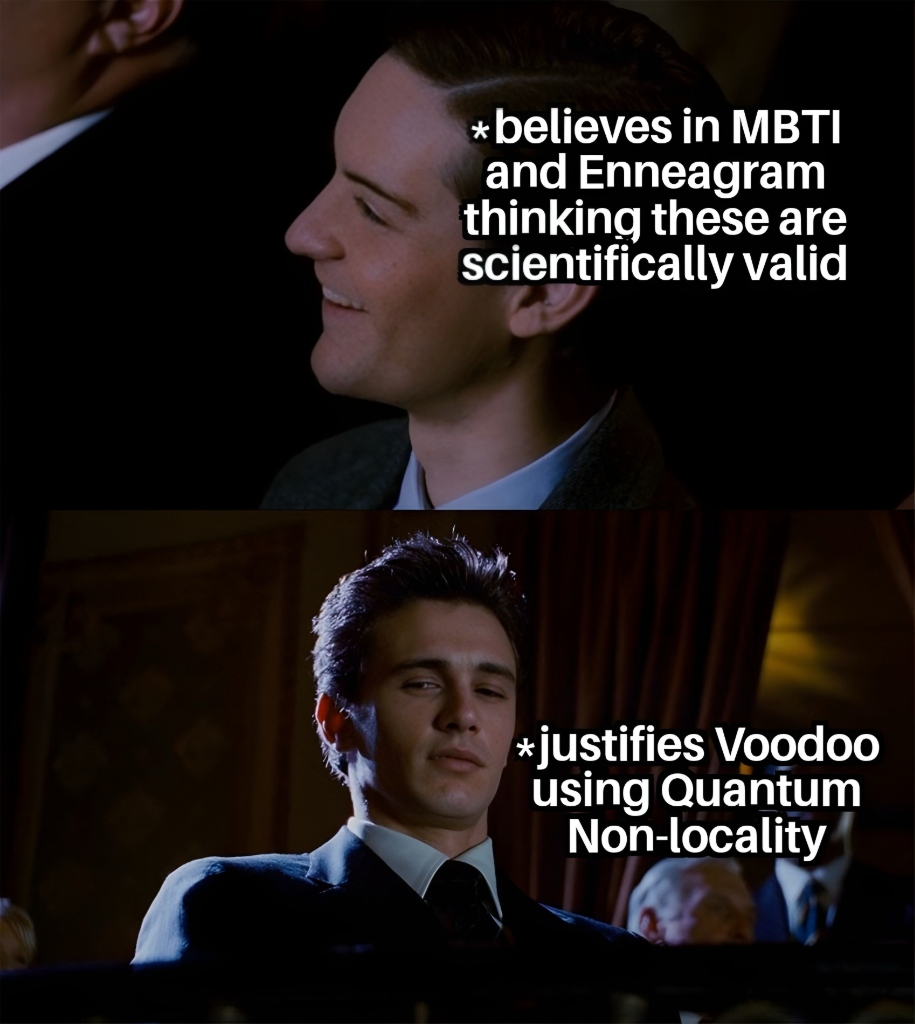
The two panels pit pop-psychology typologies against 'quantum mysticism' invokes of entanglement:
1. **Why MBTI and the Enneagram fail psychometric standards:** Neither the Myers-Briggs Type Indicator (MBTI) nor the Enneagram is supported as a taxonomy of discrete, natural personality types in empirical psychology. Measured personality dimensions distribute continuously and unimodally (clustering near the center of the distribution, as modeled in dimensional frameworks like the Big Five and HEXACO) rather than separating into bimodal peaks. Dichotomizing continuous traits at an arbitrary midpoint throws away statistical information and causes severe test-retest instability: $39\%$ to $76\%$ of people who retake the MBTI after only five weeks are assigned a different four-letter type (
Pittenger 1993). Likewise, systematic reviews of the Enneagram find mixed factor validity and heavy reliance on broad Barnum-effect descriptions (
Hook et al., 2021).
2. **Why quantum nonlocality cannot power Voodoo:** Claiming that quantum entanglement or Bell nonlocality allows manipulating an effigy $A$ to exert a targeted physical force or signal on a distant person $B$ directly violates the **quantum no-signaling theorem** (
Ghirardi, Rimini, and Weber 1980). For any shared bipartite state $\rho_{AB}$ and any local physical operation (completely positive trace-preserving map $\mathcal{E}_A$) performed on subsystem $A$, the marginal density matrix of $B$ is strictly invariant:
$$\begin{aligned}\rho_B' &= \operatorname{Tr}_A\bigl[(\mathcal{E}_A \otimes \mathcal{I}_B)(\rho_{AB})\bigr] \\ &= \operatorname{Tr}_A(\rho_{AB}) = \rho_B.\end{aligned}$$Entanglement produces non-classical correlations only when measurement records from both ends are brought together via ordinary classical communication; local actions on $A$ alone cannot transmit force, energy, or controllable effects to $B$, and warm macroscopic objects decohere almost instantaneously besides.