Truth, Proof, and the Rules of Negation

There is someone such that, if that person becomes a billionaire, everyone becomes a billionaire.
Peter's answer in the cover meme sounds like a rather ambitious economic policy. Who is this person, and how does their bank balance control everyone else's? Surprisingly, we can prove the statement without knowing anyone's wealth. Let us do that first, then ask what the proof has actually given us.
1. Can One Billionaire Make Everyone Rich?
Choose a nonempty population $U$, and fix a currency, a wealth threshold, and a deadline. Let $B(x)$ mean that person $x$ has reached billionaire status by that deadline.
$B$ is a predicate: specifying a person turns it into a proposition. Using $\exists$ for “there exists” and $\forall$ for “for every,” the meme claims
$$ \exists x\in U\;\bigl(B(x)\to\forall y\in U\,B(y)\bigr). $$
The parentheses tell us what we must find: a person for whom the whole conditional holds. A material conditional $P\to Q$ is false only when $P$ is true and $Q$ is false. We can therefore check the claim in two cases.
Suppose everyone becomes a billionaire by the deadline. Choose anyone. The conclusion of their conditional is already true, so the conditional is true.
Suppose not everyone does. Classically, there must be someone who does not. Choose that person. Their conditional has a false premise, so it is true too.
We have found a suitable person in either case. This is the drinker paradox, with billionaires replacing people drinking in a tavern. There is no contradiction. The surprise comes from reading more into the conditional than it says.
In particular, we never proved that the selected person becomes wealthy. We also never claimed that changing their wealth would change anyone else's. Both sides of the conditional are evaluated in the same fixed situation. The proof offers no mechanism for making everyone rich.
To see how much the parentheses matter, move the existential quantifier:
$$ \bigl(\exists x\in U\,B(x)\bigr)\to\forall y\in U\,B(y). $$
This says that if anyone qualifies, everyone qualifies. Two people, one above the threshold and one below it, refute this new statement. The original still holds: choose the person below the threshold.
The proof gives us two instructions for choosing a person. To follow those instructions, though, we first need to know which case we are in.
2. Where Did the Proof Get Its Witness?
Let $A$ abbreviate “everyone in $U$ becomes a billionaire.” Our case split used
$$ A\lor\neg A, $$
where $\lor$ means “or” and $\neg$ means “not.” Accepting this formula for every proposition is the law of excluded middle. It licenses the two cases even when we have no way of deciding which one holds.
We can see the same rule inside the algebra. Using the classical equivalence $P\to Q\equiv\neg P\lor Q$,
$$ \begin{aligned} \exists x\in U\,(B(x)\to A) &\equiv\exists x\in U\,(\neg B(x)\lor A)\\ &\equiv(\exists x\in U\,\neg B(x))\lor A\\ &\equiv\neg A\lor A. \end{aligned} $$
The second step works because $A$ does not depend on the selected $x$, and $U$ contains someone we can choose if $A$ holds. The final step identifies “someone does not qualify” with “not everyone qualifies.” These are classical transformations throughout. Reducing the formula this way does not, by itself, compare the strength of the drinker principle and excluded middle in weaker logical systems.
Now suppose we want the proof to supply a witness, an actual person together with a proof of their conditional. If we have a finite list of people and can decide each person's status, there is a straightforward procedure. Search the list. If we find a non-billionaire, choose them. If the search finishes without one, everyone qualifies, so choose anyone. The assumptions give us a way to carry out the choice.
The abstract argument imposed no such search assumptions. It covered arbitrary domains and predicates. Its existence claim did not require a procedure that decides which case we occupy.
This is where the constructive interpretation of proof asks for more information. To prove an existential directly, supply a witness and the required proof. To prove a disjunction directly, establish one of its alternatives. To prove an implication, give a construction that turns a proof of its premise into a proof of its conclusion. Intuitionistic logic formalizes these proof rules without adding unrestricted excluded middle.
Return to the second case. Having a proof that “everyone qualifies” leads to contradiction is different from having a particular person who does not qualify. The passage
$$ \neg\forall x\,B(x)\to\exists x\,\neg B(x) $$
is therefore not generally available intuitionistically. A refutation of a universal claim need not provide the requested counterexample.
This does not mean that negation stops interacting with quantifiers. We still have
$$ \neg\exists x\,B(x)\;\leftrightarrow\;\forall x\,\neg B(x). $$
If we can refute the existence of a qualifying person, we can refute every proposed candidate. Conversely, if we can refute each candidate, any claimed witness gives a contradiction. Neither direction asks us to choose a counterexample.
The difficulty is becoming more precise. We keep moving between a refutation and a positive claim, sometimes without noticing the step. What exactly does a proof of “not” give us?
3. If I Am Not Wrong, Am I Right?
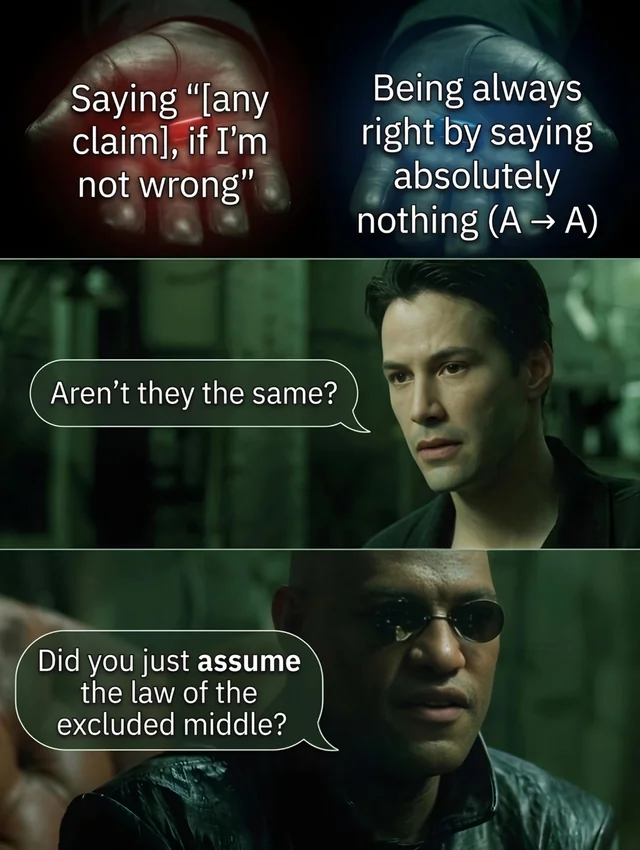
The Matrix meme puts our difficulty into an everyday phrase. Let my claim be $A$, and read “my claim is wrong” as $\neg A$. Then “I am not wrong” becomes $\neg\neg A$. Does that give us $A$ itself?
In conversation, “if I am not wrong” often just signals uncertainty. Here we are giving the phrase a specific logical reading so that we can check the step it hides.
Let $\bot$ denote a contradiction. A refutation of $A$ is a proof that assuming $A$ leads to $\bot$. This is what negation means:
$$ \neg A:=A\to\bot. $$
For a concrete example, fix an integer $n$, and let $A$ mean “$n$ is even.” A proof of $A$ supplies an integer $k$ such that $n=2k$. If $n=3$, assuming $A$ would require $k=3/2$, which is not an integer. We have therefore proved $\neg A$: the assumption that 3 is even leads to a contradiction.
Negate once more. A proof of $\neg\neg A$ shows that a refutation of $A$ would itself lead to contradiction. That is a mathematical result. It says more than “we tried to disprove $A$ and failed.” But it still does not directly hand us a proof of $A$.
Now take $n=4$. The integer $k=2$ proves $A$. Any proposed refutation of $A$ would contradict this proof, so we also obtain $\neg\neg A$. This illustrates a direction that is always available: a proof of $A$ lets us refute any refutation of $A$. The question is whether we can reverse that direction for every proposition.
We can now separate two arguments that are often both called proof by contradiction:
| Assume | Reach | Conclude |
|---|---|---|
| $A$ | $\bot$ | $\neg A$ |
| $\neg A$ | $\bot$ | $\neg\neg A$ |
The second row reaches $A$ only if we also use double-negation elimination:
$$ \neg\neg A\to A. $$
Classical logic permits this step for every proposition. The meme can then replace $\neg\neg A$ with $A$, leaving the easy identity $A\to A$: given a proof of $A$, return it. The interesting step happened before we reached that identity.
Why does the meme mention excluded middle? Suppose we have $\neg\neg A$ and are also allowed to split into $A\lor\neg A$. If the first case holds, we already have $A$. In the second case, $\neg A$ contradicts our proof of $\neg\neg A$. From a contradiction, intuitionistic logic allows any conclusion, including $A$. Excluded middle therefore supplies the missing step.
Can double-negation elimination give excluded middle back? Try assuming that $A\lor\neg A$ leads to contradiction. If we had $A$, we could produce that forbidden disjunction, so we obtain $\neg A$. But $\neg A$ also produces the very same disjunction. Our assumption has contradicted itself. We have proved
$$ \neg\neg(A\lor\neg A) $$
without using excluded middle. Now, if double-negation elimination is available for every proposition, apply it to the whole proposition $A\lor\neg A$. Excluded middle follows.

Thus the two unrestricted rules are equivalent over intuitionistic logic. “Every proposition” matters here. Being able to remove double negation from one particular $A$ does not automatically supply $A\lor\neg A$ for that same $A$. The argument above also needs to remove double negation from the larger proposition $A\lor\neg A$.
Notice what intuitionistic logic has and has not rejected. We just proved that a refutation of excluded middle leads to contradiction. The difficulty is supplying one side of its disjunction, not proving that the disjunction is false.
Return to our billionaire calculation. We replaced $P\to Q$ by $\neg P\lor Q$. Set $Q=P$, and the difference becomes visible:
$$ P\to P \qquad\text{and}\qquad \neg P\lor P. $$
The first asks us to return a proof we were given. The second asks us to establish a side. We can constructively turn $\neg P\lor Q$ into $P\to Q$, but reversing that conversion for arbitrary propositions requires an additional rule. Agreement in a Boolean truth table does not guarantee that the two proofs supply the same information.
What happens when we put two implications together?
4. Does “If and Only If” Mean XNOR?

The iff/XNOR meme compares two things that coincide for Boolean inputs. An XNOR gate reports that its inputs match. A proof of “$A$ if and only if $B$” gives us a way to turn a proof of either proposition into a proof of the other.
Keep $A$ as “$n$ is even,” and let $B$ mean “$n+2$ is even,” for the same fixed integer $n$. What would it mean to prove that these claims are equivalent?
The biconditional asks for both implications:
$$ E(A,B):=(A\to B)\land(B\to A), $$
Here $\land$ means “and.” If a proof of $A$ gives $n=2k$, then $n+2=2(k+1)$, which proves $B$. Conversely, if a proof of $B$ gives $n+2=2m$, then $n=2(m-1)$, which proves $A$. These two conversions establish $E(A,B)$. Neither needs us to perform a parity test first: each tells us how to use a starting proof once one is supplied. The conversion rules alone need not supply that starting point for arbitrary propositions.
Now ask for something more direct: establish that both propositions hold, or establish that both can be refuted. These are the two matching cases of XNOR:
$$ M(A,B):=(A\land B)\lor(\neg A\land\neg B). $$
What extra information does $M$ request? For $n=4$, we can prove that 4 and 6 are both even, supplying its first alternative. For $n=3$, we can prove that neither 3 nor 5 is even, supplying its second. A constructive proof of $M$ must provide a particular alternative together with the two proofs it requires. Giving the two conversion rules in $E$ is a different task.
A proof of $M$ does give us $E$. If both hold, we already have the conclusion needed for either implication. If both are refuted, assuming either proposition leads to contradiction, from which the other follows. Hence $M\to E$ is constructively valid.
Integer parity is decidable: we can determine whether an integer is even or odd, so we can select a matching case in this example. It illustrates what the formulas ask us to provide. The question below concerns arbitrary propositions, where no such decision procedure has been assumed.
Does $E$ give us a matching case in return? Put $B=A$. The two directions in $E(A,A)$ merely return their input proof, so they are always available. But $M(A,A)$ asks us to establish either $A$ or $\neg A$:
$$ M(A,A)\leftrightarrow A\lor\neg A. $$
Excluded middle has returned. A rule converting $E(A,B)$ into $M(A,B)$ for every pair of propositions would supply $A\lor\neg A$ for every $A$.
Excluded middle is also enough to perform that conversion. Given $E(A,B)$, split into $A$ and $\neg A$. In the first case, $A\to B$ gives $B$, so both hold. In the second, $B\to A$ lets us refute $B$, so both are refuted. The missing information was which matching case to choose.
Perhaps we can avoid choosing. XNOR also means NOT XOR: the inputs cannot differ. Let us express that by ruling out both mismatches, “$A$ holds but $B$ does not” and “$B$ holds but $A$ does not”:
$$ N(A,B):=\neg[(A\land\neg B)\lor(\neg A\land B)]. $$
In our example, one mismatch would say that $n$ is even but $n+2$ is not. The first claim supplies $n=2k$, so $n+2=2(k+1)$ proves exactly what the second claim refutes. That produces a contradiction. The other mismatch is ruled out by the reverse conversion. This is what $N$ asks us to provide: a refutation of either way the two claims could differ.
The reasoning works for arbitrary propositions whenever $E(A,B)$ is available. Use $A\to B$ against the first mismatch and $B\to A$ against the second. Together with the earlier argument, we obtain
$$ M(A,B)\longrightarrow E(A,B)\longrightarrow N(A,B). $$
In words: establishing a matching case gives both implications, and having both implications rules out a mismatch.
To test the second converse, fix $B$ to something we already know is true. We write this always-provable proposition as $\top$. Now $E(A,\top)$ gives $A$, because one of its directions starts from $\top$. But $N(A,\top)$ only rules out $\neg A$, the remaining way the inputs could differ. Thus
$$ E(A,\top)\leftrightarrow A, \qquad N(A,\top)\leftrightarrow\neg\neg A. $$
This is exactly the Matrix problem. Ruling out a mismatch gives double negation; recovering the biconditional requires a proof of $A$.
Double-negation elimination also repairs the general converse. Given $N(A,B)$ and $A$, suppose $\neg B$. That would be a forbidden mismatch, so we obtain $\neg\neg B$. Removing the double negation gives $B$. The same reasoning in the other direction gives $B\to A$.
We have therefore identified the extra rules precisely. Converting $E$ to $M$ for all propositions is equivalent to unrestricted excluded middle. Converting $N$ to $E$ for all propositions is equivalent to unrestricted double-negation elimination. Particular inputs may allow these conversions constructively; the obstruction concerns a rule that works without any such extra information.
What about the gate itself? For specified Boolean inputs, all three calculations agree:
| $A$ | $B$ | $E$ | $M$ | $N$ |
|---|---|---|---|---|
| $1$ | $1$ | $1$ | $1$ | $1$ |
| $1$ | $0$ | $0$ | $0$ | $0$ |
| $0$ | $1$ | $0$ | $0$ | $0$ |
| $0$ | $0$ | $1$ | $1$ | $1$ |
A Boolean valuation assigns each input a definite value, $0$ or $1$. That lets us evaluate every row. Constructive logic has no objection to this calculation. The distinction appears when $A$ and $B$ are arbitrary propositions and we ask what one proof lets us construct from another.
The meme works because “a matching case holds,” “each implies the other,” and “a mismatch is impossible” coincide classically. Constructively, they ask for different information. Following those differences has brought us back to the same two rules that appeared in the Matrix meme.
There is one more biconditional to test. We can prove $A\leftrightarrow A$ without deciding $A$. Could a proposition instead be equivalent to its own negation?
5. Can a Sentence Be Equivalent to Its Own Negation?
Consider the sentence
This sentence is false.
Call it $L$, and read “false” as “not true.” Before reasoning about it, let us separate two assumptions that its wording can make us take for granted.
First, suppose our language lets $L$ say that $L$ itself is not true. Second, suppose we may apply the usual truth rule to this sentence too: saying that $L$ is true is equivalent to asserting $L$.
For an ordinary example, “snow is white” is true if and only if snow is white. The risky step is allowing the same rule without restriction, including for sentences that speak about their own truth.
We can write both assumptions precisely. Let $\ulcorner L\urcorner$ name the sentence, and let $T(\ulcorner L\urcorner)$ mean “the sentence $L$ is true.” Then
$$ \begin{aligned} L&\leftrightarrow\neg T(\ulcorner L\urcorner),\\ T(\ulcorner L\urcorner)&\leftrightarrow L. \end{aligned} $$
The first formula states what the self-referential sentence says. The second applies the truth rule to it. Together they give
$$ L\leftrightarrow\neg L. $$
We already know how to read a biconditional: it supplies two implications. Here they are $L\to\neg L$ and $\neg L\to L$. Let us use them one at a time.
First, assume $L$. The first implication gives $\neg L$, so we have a contradiction. We have shown that any proof of $L$ would lead to contradiction. That is a proof of $\neg L$.
Now use the other implication. It turns the proof of $\neg L$ we just obtained into a proof of $L$. Applying our refutation to that proof gives a contradiction again.
We never had to decide between $L$ and $\neg L$. We first constructed a refutation, then used one of our assumptions to construct the very proposition it refuted. Neither excluded middle nor double-negation elimination entered the argument. Dropping those classical rules does not solve this paradox.
The incompatible assumptions are now visible: we admitted this self-referential sentence, applied the truth rule to it, and retained the ordinary rules for implication and negation. Self-reference alone did not produce the contradiction. The truth rule supplied the second part of the trap.
In the billionaire argument, careful formalization explained how a surprising conditional could be true without providing a mechanism for making anyone rich. Here it reveals that the two directions demanded by the sentence cannot coexist. The useful habit is the same: state what the sentence means, identify the assumptions, and follow the inference that does the work.
6. Can We Check These Steps Ourselves?
The last argument is short enough to check line by line. Lean is a proof assistant: we state the assumptions and conclusion, then supply a proof that its kernel checks. Here L : Prop declares a proposition, h supplies the two directions of the biconditional, and False is the contradiction we must derive.
theorem liar_no_em {L : Prop} (h : L ↔ ¬ L) : False := by
  have notL : ¬ L := by
    intro l
    exact (h.mp l) l
  have l : L := h.mpr notL
  exact notL l
Read h.mp as the forward implication and h.mpr as the reverse. The indented proof under have notL first assumes a proof l of $L$, obtains its refutation through h.mp, and applies that refutation to l. This constructs $\neg L$. The next line uses the reverse implication to obtain $L$, and the final line applies the refutation to it. These are exactly the two steps above.
The small commands are instructions for building that proof: intro introduces an assumed input, have names an intermediate result, and exact supplies the proof needed at the current step.
The browser example needs no installation. It opens Lean 4.19.0 with seven annotated proofs, including $M\to E\to N$, a converse with its extra assumption written explicitly, and the liar contradiction. Place the cursor inside a proof to inspect its hypotheses and goal. As a small experiment, change h.1 to h.2 in the first case of e_to_n. Lean will object because the supplied proof has the wrong type. Restore it and follow why the original direction works.
Open All Messages to inspect the #print axioms results. Each of these proofs has an empty list of additional axiom dependencies. An explicit hypothesis is still a hypothesis: the converse does not become unconditional just because its axiom list is empty.
The full project adds 47 checked theorem declarations, including the equivalences with unrestricted excluded middle and double-negation elimination, and the three-element Heyting-algebra counterexamples. The guide distinguishes those finite countermodels from proofs over arbitrary propositions and gives the commands to repeat every check locally.
Further Reading
For the logical details, see Warren, Diener, and McKubre-Jordens on the drinker paradox and its dual, Robert Harper's Constructive Negation, and Sections 7–9 of Alfred Tarski's The Semantic Conception of Truth.