Trisecting an Angle: With Ruler and Compass
Can any given angle be divided into three equal parts using only an unmarked straightedge and a compass?
Alongside doubling the cube and squaring the circle, angle trisection is one of the three classical geometric problems of antiquity. For over two millennia, mathematicians searched in vain for a general ruler-and-compass procedure, or tried to explain why none could be found. When the answer finally arrived in 1837 through the work of Pierre Wantzel, it came not from drawing more circles, but from field theory and abstract algebra.
Let us trace how straightedge-and-compass operations translate into towers of quadratic field extensions, why the triple-angle identity hides an irreducible cubic polynomial, and how relaxing a single axiom via Archimedes' Neusis construction solves the cubic mechanically.
1. The Algebraic Limits of Straightedge and Compass
To see what a straightedge and compass can and cannot construct, place your starting points in the Cartesian plane so that the initial segment defines the unit length $1$. Every new point you construct comes from one of three geometric intersections:
- The intersection of two lines: Solving two linear equations $a_1 x + b_1 y = c_1$ and $a_2 x + b_2 y = c_2$ uses only addition, subtraction, multiplication, and division. The coordinates remain inside the same number field $F$.
- The intersection of a line and a circle: Substituting a linear equation into $(x - h)^2 + (y - k)^2 = r^2$ produces a quadratic equation over $F$, which at most introduces a single square root $\sqrt{d}$ with $d \in F$.
- The intersection of two circles: Subtracting two circle equations cancels the $x^2 + y^2$ terms and reduces immediately to the intersection of a line and a circle.
Why can a compass extract square roots? If you construct a right triangle with hypotenuse $x + 1$ and base $x - 1$, the Pythagorean theorem gives the altitude $\sqrt{(x+1)^2 - (x-1)^2} = 2\sqrt{x}$, which bisection halves to $\sqrt{x}$.
By chaining these intersections finitely many times, a real number $\alpha \in \mathbb{R}$ is constructible from $\mathbb{Q}$ if and only if it lies at the top of a tower of quadratic field extensions:
$$\mathbb{Q} = F_0 \subset F_1 \subset F_2 \subset \cdots \subset F_k, \qquad [F_{j} : F_{j-1}] = 2$$
By the Tower Law for field extensions, the degree of the minimal polynomial of any constructible number $\alpha$ over $\mathbb{Q}$ must be a power of $2$:
$$[\mathbb{Q}(\alpha) : \mathbb{Q}] = 2^m \qquad (m \in \mathbb{N} = \{0, 1, 2, \dots\})$$
In particular, since $3$ is not a power of $2$, no root of an irreducible cubic polynomial over $\mathbb{Q}$ can ever be constructed with an unmarked straightedge and compass!
2. The Cubic Polynomial Hidden Inside $\cos\theta$
Where does a cubic polynomial enter angle trisection? An angle $\phi$ is constructible if and only if the horizontal projection of a unit radius at angle $\phi$, namely $\cos\phi$, is a constructible length.
Suppose we are given a constructible angle $\theta$ (so $a = \cos\theta$ is known) and we wish to construct $\theta / 3$ (which is equivalent to constructing $x = \cos(\theta / 3)$). By De Moivre's formula on the unit circle in the complex plane:
$$\cos\theta + i\sin\theta = e^{i\theta} = \left(e^{i\theta/3}\right)^3 = \left(\cos(\theta/3) + i\sin(\theta/3)\right)^3$$
Expanding the cube and equating real parts using $\sin^2(\theta/3) = 1 - \cos^2(\theta/3)$ yields the triple-angle cosine identity:
$$\cos\theta = 4\cos^3(\theta/3) - 3\cos(\theta/3)$$
Writing $x = \cos(\theta/3)$ and $a = \cos\theta$, trisecting the angle $\theta$ is algebraically identical to constructing a root of the cubic polynomial:
$$4x^3 - 3x - a = 0$$
3. Wantzel's Counterexample: Why $60^\circ$ Cannot Be Trisected
To prove that no general ruler-and-compass trisection exists, we only need one constructible angle whose cubic is irreducible over $\mathbb{Q}$. Take the equilateral triangle angle $\theta = 60^\circ$, which is trivially constructible with a single circle and has $a = \cos 60^\circ = \frac{1}{2}$.
Trisecting $60^\circ$ into $20^\circ$ requires constructing $x = \cos 20^\circ$, which satisfies:
$$4x^3 - 3x - \frac{1}{2} = 0 \quad \Longleftrightarrow \quad 8x^3 - 6x - 1 = 0$$
To clear the leading coefficient, substitute $u = 2x = 2\cos 20^\circ$. The equation becomes a monic cubic with integer coefficients:
$$P(u) = u^3 - 3u - 1 = 0$$
Is $P(u) = u^3 - 3u - 1$ reducible over the rational numbers $\mathbb{Q}$? Because its degree is $3$, any factorization over $\mathbb{Q}$ would have to include a linear factor, meaning $P(u)$ would have a rational root $u = p/q$. By the Rational Root Theorem, the only possible rational roots of a monic integer polynomial with constant term $-1$ are $u = \pm 1$:
- $P(+1) = 1^3 - 3(1) - 1 = -3 \neq 0$
- $P(-1) = (-1)^3 - 3(-1) - 1 = +1 \neq 0$
Neither is a root! Therefore, $u^3 - 3u - 1$ is irreducible over $\mathbb{Q}$, which forces the field extension degree to be:
$$[\mathbb{Q}(\cos 20^\circ) : \mathbb{Q}] = 3 \neq 2^m$$
Because $3$ is not a power of $2$, $\cos 20^\circ$ does not lie in any tower of quadratic extensions. It is mathematically impossible to trisect a $60^\circ$ angle in finitely many steps with an unmarked straightedge and compass.
4. Why Special Angles Like $90^\circ$ Can Be Trisected
The impossibility theorem rules out a universal procedure that works for every angle $\theta$; it does not forbid trisecting specific angles when the cubic happens to factor!
For example, take $\theta = 90^\circ$, where $a = \cos 90^\circ = 0$. The cubic equation factors immediately into a linear factor and a quadratic factor:
$$4x^3 - 3x = x(4x^2 - 3) = 0 \implies x = 0 \quad \text{or} \quad x = \pm\frac{\sqrt{3}}{2}$$
Because $\cos 30^\circ = \frac{\sqrt{3}}{2}$ satisfies a quadratic equation ($[\mathbb{Q}(\sqrt{3}) : \mathbb{Q}] = 2^1$), trisecting $90^\circ$ into $30^\circ$ requires only a single compass arc.
5. Changing the Axioms: Archimedes' Neusis Construction
What happens if we allow two distance marks on our straightedge (or use the Huzita-Hatori axioms of mathematical origami paper folding)? Both tools introduce cubic intersections, expanding the field of constructible numbers to include towers of degree $2^a 3^b$!
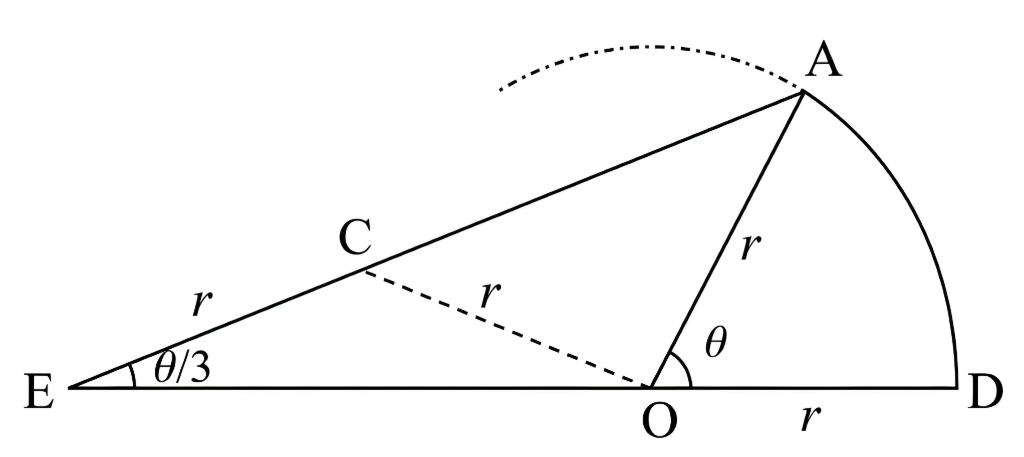
Around 250 BCE, Archimedes showed how a ruler marked with a single fixed length $r$ trisects any acute angle $\angle AOB = \theta$ in one stroke via a Neusis (verging) construction:
- Center a circle of radius $r$ at the vertex $O$, intersecting the two rays of $\angle AOB = \theta$ at points $A$ and $B$ (so $|OA| = |OB| = r$).
- Extend the baseline ray $BO$ backward past $O$ to the left.
- Place a ruler with two marks spaced by the exact radius $r$ so that its edge passes through $A$, while you slide and pivot it until one mark $C$ sits on the circle ($|OC| = r$) and the second mark $E$ sits on the extended baseline ($|CE| = r$).
Why does the resulting acute angle $\beta := \angle AEO$ at the left tip equal exactly $\theta / 3$? Follow the two isosceles triangles in three lines of Euclidean geometry:
- Because $|EC| = |CO| = r$, triangle $\triangle ECO$ is isosceles, so $\angle CEO = \angle COE = \beta$.
- By the exterior angle theorem applied to $\triangle ECO$, the interior angle at $C$ is $\angle OCA = \angle CEO + \angle COE = 2\beta$.
- Because $|OA| = |OC| = r$, triangle $\triangle OAC$ is also isosceles, so $\angle OAC = \angle OCA = 2\beta$.
- Finally, apply the exterior angle theorem to the large triangle $\triangle AEO$: the exterior angle at $O$ is $\theta = \angle AOB = \angle AEO + \angle OAE = \beta + 2\beta = 3\beta$, so $\beta = \theta / 3$!
Where did the cubic equation go? Sliding a fixed-length segment $|CE| = r$ along a line while keeping its line of action passing through $A$ traces a fourth-degree algebraic curve called the Conchoid of Nicomedes, whose intersection with the circle of radius $r$ mechanically solves $4x^3 - 3x - \cos\theta = 0$!
Originally published in Bengali as "রুলার ও কম্পাস দিয়ে কোণ ত্রিখণ্ডন" on Prothom Alo.