Topological Quantum Computing: When a Full Braid Flips a Qubit
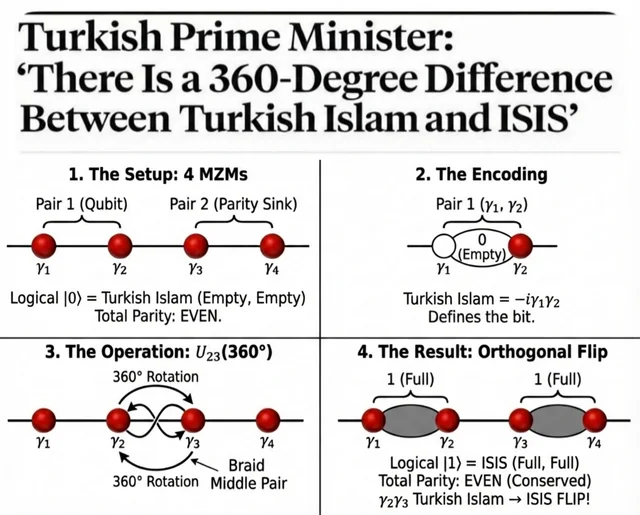
When someone says they have “changed by $360^\circ$,” we usually point out that a full turn brings them back to where they started. Yet the meme above suggests that a $360^\circ$ braid can turn a quantum $|0_L\rangle$ into $|1_L\rangle$!
This raises a useful question: how can returning a system to its original configuration perform a computation?
For an electron's spin, a $360^\circ$ spatial rotation contributes a minus sign to the state vector. That sign alone does not turn $|0\rangle$ into the orthogonal state $|1\rangle$. The operation illustrated here is different: a full braid of two modes acts on a qubit encoded jointly across four modes. Let us build that encoding and derive exactly when the claimed bit flip occurs.
1. From Exchange Paths to Anyons
A qubit is described by a normalized complex state vector
$$|\psi\rangle=\alpha|0\rangle+\beta|1\rangle,\qquad |\alpha|^2+|\beta|^2=1.$$
Measuring in the basis $\{|0\rangle,|1\rangle\}$ gives probabilities $|\alpha|^2$ and $|\beta|^2$. The relative phase between the amplitudes also matters, because it affects interference and measurements in other bases. Multiplying both amplitudes by the same phase $e^{i\chi}$ leaves the physical state unchanged.
A coherent, reversible gate acts through a unitary matrix satisfying $U^\dagger U=I$, where $\dagger$ means conjugate transpose and $I$ is the identity. This condition preserves normalization. Our aim is to obtain such a matrix by moving physical objects along paths.
Why seek a special physical encoding? Consider a disturbance that changes $\alpha|0\rangle+\beta|1\rangle$ into $\alpha|0\rangle-\beta|1\rangle$. The computational-basis probabilities are unchanged, yet the interference has changed. In particular, $(|0\rangle+|1\rangle)/\sqrt2$ becomes the orthogonal state $(|0\rangle-|1\rangle)/\sqrt2$. Protecting a quantum bit therefore requires preserving relative phases as well as basis-state populations. Storing information in collective properties of separated objects offers one way to limit what a local disturbance can affect.
Imagine localized excitations moving in a plane. An excitation is a state of the material above a chosen reference state, rather than necessarily an elementary particle. In effectively two-dimensional systems, excitations called anyons can have exchange statistics beyond the familiar bosonic and fermionic cases.
To describe an exchange, draw the trajectories with time as the vertical direction. They form strands of a braid. Two exchanges in the same direction return the objects to their original positions while producing a full winding. An exchange followed by its inverse cancels the winding.
The distinction survives small changes to the paths. We can stretch or bend a trajectory continuously, but cannot pass one object through another. Equivalence classes under these allowed deformations form the braid group.
For Abelian anyons, an exchange contributes a phase, and phase factors commute. For non-Abelian anyons, the system has several states that exchanges can mix through matrices. Changing the exchange order can then change the final physical state.
Those internal states can share the same energy while encoding different information. Returning the objects to their original positions therefore does not determine the internal state: the exchange path may have transformed its amplitudes. This is the mathematical opportunity for computation. We must still identify a physical model whose exchange rule produces a useful matrix.
Certain ideal superconducting models contain defects supporting Majorana zero modes, whose exchanges realize this second possibility. A Majorana mode is a localized quantum degree of freedom associated with a defect. It is not an ordinary electron being carried around a circle.
2. Why Four Majorana Modes Give One Logical Qubit
The operator of an ideal Majorana zero mode is Hermitian,
$$\gamma^\dagger=\gamma,$$
and commutes with the ideal Hamiltonian $H$:
$$[H,\gamma]:=H\gamma-\gamma H=0.$$
The Hamiltonian describes the system's energy. If $H|E\rangle=E|E\rangle$, then
$$H\gamma|E\rangle=\gamma H|E\rangle=E\gamma|E\rangle.$$
Thus $\gamma$ connects equal-energy states. This is the meaning of “zero mode” in the ideal model.
Take four Majorana operators satisfying
$$\{\gamma_j,\gamma_k\}:=\gamma_j\gamma_k+\gamma_k\gamma_j =2\delta_{jk}I.$$
The Kronecker delta $\delta_{jk}$ equals $1$ for $j=k$ and $0$ otherwise. Consequently, $\gamma_j^2=I$, while distinct operators anticommute: $\gamma_j\gamma_k=-\gamma_k\gamma_j$.
Two Majorana operators combine into one ordinary fermionic annihilation operator. Define
$$f_1=\frac{\gamma_1+i\gamma_2}{2},\qquad f_2=\frac{\gamma_3+i\gamma_4}{2},\qquad i^2=-1.$$
Conversely, $\gamma_1=f_1+f_1^\dagger$ and $\gamma_2=-i(f_1-f_1^\dagger)$. The two Hermitian operators are the algebraic components of one complex fermionic mode. This decomposition is possible for an ordinary fermionic operator as well. What makes the proposed encoding physically special is the additional requirement that the components correspond to spatially separated, localized zero modes of a suitable Hamiltonian. Rewriting an operator into two Hermitian parts alone does not establish that property.
The adjoints $f_j^\dagger$ create occupations. The Majorana relations give $\{f_j,f_k^\dagger\}=\delta_{jk}I$ and $f_j^2=0$. For the number operator $n_j=f_j^\dagger f_j$,
$$n_j^2 =f_j^\dagger f_jf_j^\dagger f_j =f_j^\dagger(I-f_j^\dagger f_j)f_j=n_j.$$
Every occupation eigenvalue therefore satisfies $n^2=n$, so it is either $0$ or $1$. Two fermionic modes give four occupation states: $|00\rangle$, $|01\rangle$, $|10\rangle$, and $|11\rangle$.
Now impose conserved fermion parity, meaning whether the total occupation is even or odd:
$$P=(I-2n_1)(I-2n_2).$$
The even-parity states are $|00\rangle$ and $|11\rangle$. They span our logical qubit:
$$|0_L\rangle:=|00\rangle,\qquad |1_L\rangle:=|11\rangle=f_1^\dagger f_2^\dagger|00\rangle.$$
The creation-operator order fixes the sign convention. The subscript $L$ indicates a logical encoding across several modes.
Why are two Majorana modes insufficient under fixed parity? They provide just one fermionic occupation, whose empty and occupied states have opposite parity. Fixing parity leaves only one state. Four modes provide two states of the same parity, allowing the superposition $\alpha|0_L\rangle+\beta|1_L\rangle$.
The encoding is also nonlocal when its Majorana modes are spatially separated. For example,
$$n_1=\frac{(\gamma_1-i\gamma_2)(\gamma_1+i\gamma_2)}{4} =\frac{I+i\gamma_1\gamma_2}{2}.$$
The occupation distinguishing $|00\rangle$ from $|11\rangle$ involves a pair of separated Majoranas. It is not a local occupation stored independently at either endpoint.
3. Deriving the Unitary for a Majorana Exchange
To keep every sign explicit, use the Pauli matrices
$$X=\begin{pmatrix}0&1\\1&0\end{pmatrix},\quad Y=\begin{pmatrix}0&-i\\i&0\end{pmatrix},\quad Z=\begin{pmatrix}1&0\\0&-1\end{pmatrix}.$$
They obey $X^2=Y^2=Z^2=I_2$ and $XY=iZ$, $YZ=iX$, $ZX=iY$. Reversing the order changes the sign.
Represent the Majorana operators on the two occupation labels by
$$\gamma_1=X\otimes I_2,\qquad \gamma_2=Y\otimes I_2,$$
$$\gamma_3=Z\otimes X,\qquad \gamma_4=Z\otimes Y.$$
Here $(A\otimes B)|ab\rangle=(A|a\rangle)\otimes(B|b\rangle)$. The $Z$ factors enforce anticommutation between the fermionic modes. These tensor factors label occupations; they do not assign a separate qubit to each Majorana.
Multiplying the middle pair gives
$$\gamma_2\gamma_3=(YZ)\otimes X=iX\otimes X.$$
Since $X\otimes X$ swaps $|00\rangle$ and $|11\rangle$,
$$\left.\gamma_2\gamma_3\right|_L=iX_L.$$
Similarly, $\left.\gamma_1\gamma_2\right|_L=iZ_L$, where $Z_L$ leaves $|0_L\rangle$ unchanged and multiplies $|1_L\rangle$ by $-1$.
The physical exchange rule of the ideal model, for one chosen orientation, is
$$\gamma_2\longmapsto-\gamma_3,\qquad \gamma_3\longmapsto\gamma_2.$$
How do we construct a unitary that implements this rule? Set $G=\gamma_2\gamma_3$. Its properties are
$$G^\dagger=-G,\qquad G^2=-\gamma_2^2\gamma_3^2=-I.$$
Separating the exponential series into even and odd powers gives
$$B(\eta):=e^{\eta G} =\left(1-\frac{\eta^2}{2!}+\cdots\right)I +\left(\eta-\frac{\eta^3}{3!}+\cdots\right)G =\cos\eta\,I+\sin\eta\,G.$$
Using $G\gamma_2=-\gamma_3$ and $G\gamma_3=\gamma_2$, direct multiplication yields
$$B(\eta)\gamma_2B(\eta)^\dagger =\cos(2\eta)\gamma_2-\sin(2\eta)\gamma_3,$$
$$B(\eta)\gamma_3B(\eta)^\dagger =\sin(2\eta)\gamma_2+\cos(2\eta)\gamma_3.$$
We obtain the required signed exchange when $2\eta=\pi/2$. Therefore,
$$B_{23}=e^{\pi\gamma_2\gamma_3/4} =\frac{I+\gamma_2\gamma_3}{\sqrt2}.$$
This explains the factor $\pi/4$. The exchange rule is the physical input; its matrix implementation follows from the algebra.
The gate is unitary because
$$B_{23}^\dagger B_{23} =\frac{(I-G)(I+G)}2 =\frac{I-G^2}{2}=I.$$
A product of two Majorana operators preserves parity, so the exchange stays within our encoded subspace. The physical exchange can also contribute a common phase $e^{i\chi}$. We describe its logical action up to that phase.
4. A Full Braid, a Bit Flip, and Noncommuting Orders
Within the logical subspace,
$$B_{23}=\frac{I_L+iX_L}{\sqrt2}.$$
One exchange therefore creates a superposition:
$$B_{23}|0_L\rangle =\frac{|0_L\rangle+i|1_L\rangle}{\sqrt2}.$$
Now perform the same exchange again. Since $G^2=-I$,
$$B_{23}^2=\frac{I+2G+G^2}{2}=G,$$
and hence
$$\left.B_{23}^2\right|_L=iX_L, \qquad B_{23}^2|0_L\rangle=i|1_L\rangle.$$
This is the precise claim illustrated by the meme: a full braid of modes $2$ and $3$ flips the logical computational basis states, up to phase. The modes return to their original positions, but the encoded amplitudes have been exchanged.
For a general input,
$$B_{23}^2(\alpha|0_L\rangle+\beta|1_L\rangle) =i(\beta|0_L\rangle+\alpha|1_L\rangle).$$
An $X_L$ eigenstate returns to the same physical state. Thus a bit flip does not make every possible input orthogonal to itself.
We can test orthogonality directly. The overlap between an input and its double-braid output is
$$\langle\psi_L|iX_L|\psi_L\rangle =i(\bar\alpha\beta+\bar\beta\alpha) =2i\operatorname{Re}(\bar\alpha\beta).$$
Here a bar denotes complex conjugation. The overlap vanishes for $|0_L\rangle$ and $|1_L\rangle$, but need not vanish for a general superposition. This calculation fixes exactly how broadly the meme's statement applies.
The direction and chosen pair also matter. Reversing the full braid gives $-iX_L$, with the same logical bit-flip action. An exchange followed by its inverse gives $I$. Four same-direction exchanges give $B_{23}^4=-I$ in our phase convention. A double exchange of modes $1$ and $2$ instead gives $iZ_L$.
To see what makes the statistics non-Abelian, compare the adjacent exchanges
$$B_{12}=\frac{I_L+iZ_L}{\sqrt2},\qquad B_{23}=\frac{I_L+iX_L}{\sqrt2}.$$
With the rightmost operation acting first,
$$B_{12}B_{23}|0_L\rangle =e^{i\pi/4}\frac{|0_L\rangle+|1_L\rangle}{\sqrt2},$$
$$B_{23}B_{12}|0_L\rangle =e^{i\pi/4}\frac{|0_L\rangle+i|1_L\rangle}{\sqrt2}.$$
The first state is an eigenstate of $X_L$ with eigenvalue $+1$. The second has overlap $(1+i)/2$ with that eigenstate, up to overall phase, giving probability $|(1+i)/2|^2=1/2$.
Exchange order has changed a measurable prediction. This is stronger than the appearance of an overall phase and directly establishes noncommutativity in the logical state space.
5. What Does Topology Actually Protect?
We now have logical gates, but why should this encoding resist noise? The locality argument can be seen directly in the ideal zero-mode algebra.
An operator supported near only one Majorana has the form $aI+b\gamma_j$ after all higher powers are reduced using $\gamma_j^2=I$. If the disturbance preserves fermion parity, the term proportional to $\gamma_j$ is excluded because it changes parity. The remaining term is proportional to the identity, so it cannot distinguish or mix the logical states.
This argument concerns operators projected into the ideal low-energy model. Spatial separation suppresses direct interactions between different modes, while a logical operation involves products connecting them. That is the role of the nonlocal encoding.
The path adds a second kind of robustness. Smoothly changing an exchange trajectory while preserving its braid class and the model's physical conditions leaves the intended logical braid operation unchanged, up to a common phase.
What happens when those conditions fail? The encoded states must be separated from unwanted excitations by an energy gap. Motion must be adiabatic, meaning sufficiently slow to suppress transitions across this gap. Faster motion can leave the encoded space.
Two energy scales must be distinguished here. We want a substantial gap between the encoded sector and unwanted states, but the states inside the encoded sector should ideally remain degenerate. A large gap outside protects against excitation; a small splitting inside prevents the logical amplitudes from acquiring different uncontrolled dynamical phases.
Making the operation indefinitely slow is not the solution either. Finite overlap between Majorana modes can produce an unwanted Hamiltonian within the code. For example, suppose this residual Hamiltonian is diagonal in our logical basis, with energies $E_0,E_1$ and splitting $\epsilon=E_1-E_0$. Over duration $\tau$,
$$\alpha|0_L\rangle+\beta|1_L\rangle \longmapsto e^{-iE_0\tau/\hbar} \left(\alpha|0_L\rangle+e^{-i\epsilon\tau/\hbar}\beta|1_L\rangle\right).$$
Here $\hbar$ is the reduced Planck constant. The common phase cancels physically, but the relative phase $\epsilon\tau/\hbar$ remains. A useful operating regime suppresses both excitations and unwanted relative-phase accumulation.
More general overlap terms can also mix the chosen logical basis states. The diagonal example isolates one mechanism and shows why the duration of a braid still matters even when its topological path class is correct.
Parity changes are another limitation. Quasiparticle poisoning occurs when an unwanted fermionic excitation enters or leaves the encoded system, changing its parity. Such a process falls outside the parity-preserving disturbance argument above.
Thus the protection follows from locality, a suitable gap, and parity conservation together. The algebra identifies the intended behavior; realizing these conditions and measuring their imperfections remains a physical problem.
6. Why This Majorana Braid Model Is Not Universal
Noncommuting gates do not automatically supply every gate needed for quantum computation. A universal gate set must approximate arbitrary desired unitary operations to increasing accuracy through compositions.
The restriction we now derive concerns the Majorana braid model used in this article. It is not a conclusion that every possible topological encoding has the same available gates.
Majorana exchanges act as signed permutations of the Majorana operators. In our encoding, the resulting gates are Clifford gates: conjugation maps each logical Pauli operator to another Pauli operator, possibly with a minus sign. For example,
$$B_{12}X_LB_{12}^\dagger=-Y_L,\qquad B_{23}Z_LB_{23}^\dagger=Y_L.$$
Here $Y_L$ is the Pauli-$y$ matrix in the logical basis. Repeating such operations continues to permute the same Pauli axes. It cannot generate an arbitrary direction between them.
Consider the phase gate
$$T=\begin{pmatrix}1&0\\0&e^{i\pi/4}\end{pmatrix}.$$
Its action on $X_L$ is
$$TX_LT^\dagger =\begin{pmatrix}0&e^{-i\pi/4}\\e^{i\pi/4}&0\end{pmatrix} =\frac{X_L+Y_L}{\sqrt2}.$$
This is not a single Pauli operator. Therefore $T$ is non-Clifford, and Majorana braiding alone cannot supply it.
Universal computation requires an additional resource, such as a non-Clifford gate or a suitably prepared auxiliary state consumed through measurements and Clifford gates. One representative resource state is
$$|A_L\rangle=T\frac{|0_L\rangle+|1_L\rangle}{\sqrt2} =\frac{|0_L\rangle+e^{i\pi/4}|1_L\rangle}{\sqrt2}.$$
Such states are called magic states because they supply the non-Clifford resource missing from Clifford operations. Preparing them with sufficient fidelity is an additional task. The same calculation that gives us a logical bit flip from a full braid also lets us identify precisely which computational capability that braid construction still lacks.