Special Relativity from First Principles: Lorentz Boosts, Magnetism & the Speed of Light
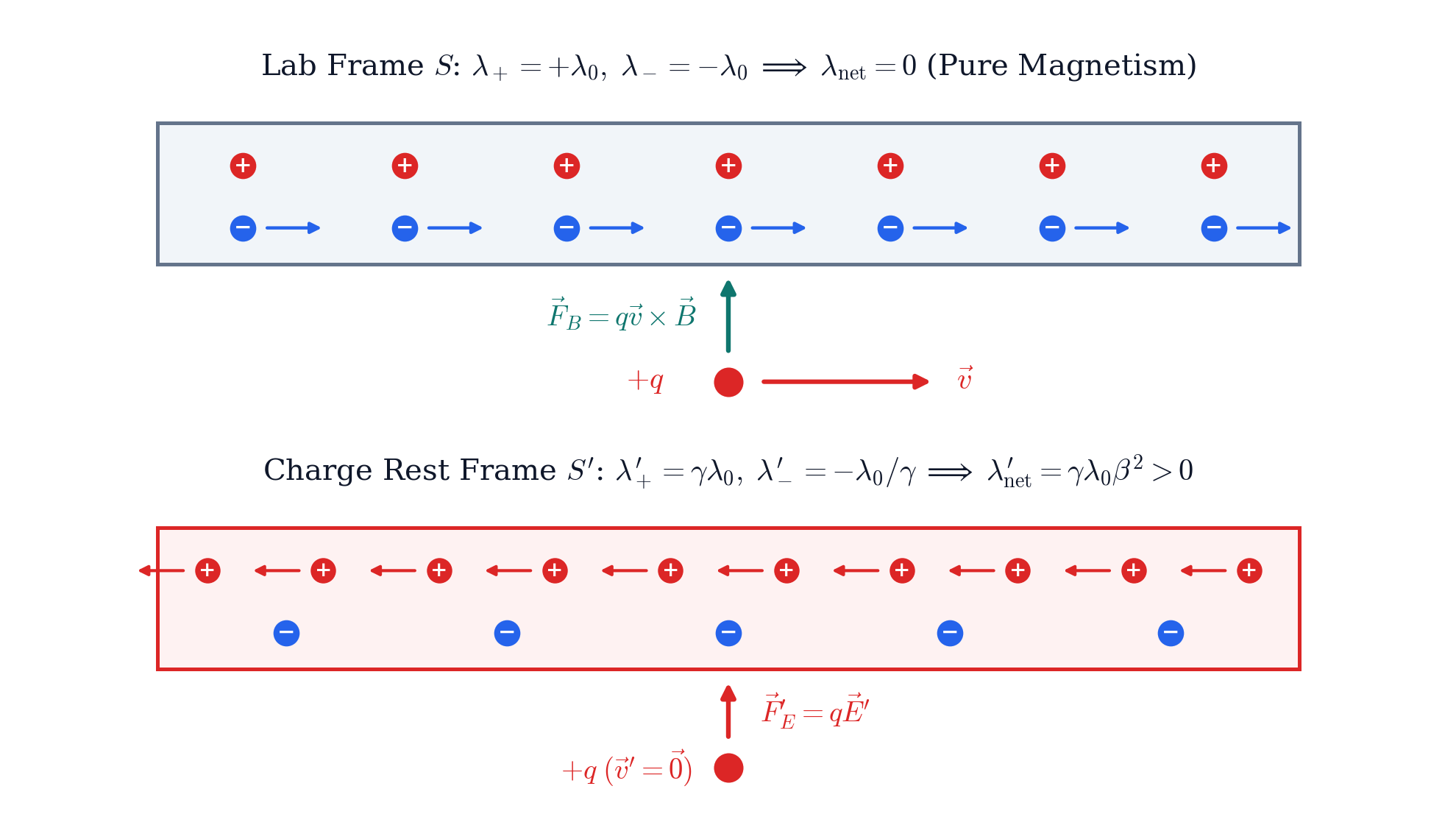
Why does the speed of light $c$ act as an unbreakable cosmic speed limit: forcing massless photons to travel strictly at $c$ while forbidding massive particles from ever reaching it? And how does this same relativistic geometry explain why a simple copper wire carrying slow-moving electrons produces a magnetic field in the laboratory?
In this first-principles exposition, we build the entire chain from the ground up:
- Part I: Deriving the Lorentz Transformation via Linear Algebra: Starting solely from the invariance of the light cone ($x = \pm ct$), we use eigenvectors and spectral decomposition of $2 \times 2$ matrices to derive the Lorentz boost and visualize how spacetime axes tilt.
- Part II: Why Magnetic Fields Exist (Purcell's Mechanism): Deriving unit-length Lorentz contraction ($1 \mapsto 1/\gamma$) and applying it to the moving electrons and stationary ions in a current-carrying wire, we show that the magnetic force $\vec{F} = q(\vec{v} \times \vec{B})$ is a direct relativistic consequence of Coulomb's electrostatic law.
- Part III: Relativistic Kinematics & the Speed of Light Limit: Using the four-momentum dispersion relation $E^2 = p^2 c^2 + m^2 c^4$, we prove why $v = c \iff m = 0$ (photons), $m > 0 \implies v < c$ (massive particles), and $v > c \iff m^2 < 0$ (tachyonic instability).
Part I: Deriving the Lorentz Transformation Using Linear Algebra
To describe a physical event completely, we specify both where and when it occurs as a point on a spacetime diagram. Restricting motion to the $x$-axis alongside the time axis, we multiply time $t$ by the vacuum speed of light $c$ so that both coordinates share units of length: $(x, ct)$.
In these coordinates, a light pulse emitted from the origin travels along $x = \pm ct$, forming $45^\circ$ lines (the light cone), while an object moving at constant velocity $v$ follows the worldline:
$$x = vt = \frac{v}{c}\,ct = \beta\,ct, \qquad \beta \equiv \frac{v}{c}$$
1. Galilean Transformation and Its Failure
Suppose you are at rest in an inertial frame $S$ with coordinates $(x, ct)$, and your friend is in frame $S'$ with coordinates $(x', ct')$ moving at uniform velocity $v$ along the $+x$-axis relative to $S$ (with origins coinciding at $t = t' = 0$). In classical (Galilean) mechanics, time is universal and coordinates transform as $x' = x - \beta\,ct$ and $ct' = ct$.
However, Galilean relativity fails for electromagnetism: a light ray satisfying $x = ct$ in frame $S$ would follow $x' = (1 - \beta)\,ct'$ in frame $S'$, meaning its measured speed would be $c(1 - \beta)$ instead of $c$. To preserve Einstein's postulate that the speed of light is invariant in all inertial frames while keeping the spatial origin of $S'$ along $x' = 0 \iff x = \beta\,ct$, the spatial coordinate must be rescaled by a velocity-dependent factor $\gamma$:
$$x' = \gamma\,(x - \beta\,ct)$$
2. Invariance of the Light Cone and Eigenvectors
Because free particles move along straight worldlines in every inertial frame, the spacetime transformation between $(x, ct)$ and $(x', ct')$ must be linear:
$$\begin{pmatrix} x' \\ ct' \end{pmatrix} = T \begin{pmatrix} x \\ ct \end{pmatrix}$$
where $T$ is a $2 \times 2$ transformation matrix. Now comes the key linear-algebra insight: light rays must remain light rays.
- A right-moving light ray satisfies $x = ct$, so its spacetime vector is proportional to $\begin{pmatrix} 1 \\ 1 \end{pmatrix}$. In frame $S'$, it must still satisfy $x' = ct'$, meaning $T\begin{pmatrix} 1 \\ 1 \end{pmatrix}$ is a scalar multiple of $\begin{pmatrix} 1 \\ 1 \end{pmatrix}$.
- A left-moving light ray satisfies $x = -ct$, so its spacetime vector is proportional to $\begin{pmatrix} 1 \\ -1 \end{pmatrix}$. In frame $S'$, it must still satisfy $x' = -ct'$, meaning $T\begin{pmatrix} 1 \\ -1 \end{pmatrix}$ is a scalar multiple of $\begin{pmatrix} 1 \\ -1 \end{pmatrix}$.
In the language of linear algebra, $\begin{pmatrix} 1 \\ 1 \end{pmatrix}$ and $\begin{pmatrix} 1 \\ -1 \end{pmatrix}$ are orthogonal eigenvectors of $T$! Any $2 \times 2$ matrix with these two orthogonal eigenvectors can be written as a spectral decomposition:
$$T = a \begin{pmatrix} 1 \\ 1 \end{pmatrix}\begin{pmatrix} 1 & 1 \end{pmatrix} + b \begin{pmatrix} 1 \\ -1 \end{pmatrix}\begin{pmatrix} 1 & -1 \end{pmatrix} = \begin{pmatrix} a + b & a - b \\ a - b & a + b \end{pmatrix}$$
Notice that both diagonal entries are equal ($a + b$), and both off-diagonal entries are equal ($a - b$), so $T$ is necessarily symmetric. From $x' = \gamma x - \gamma\beta\,ct$, the first row of $T$ is $\begin{pmatrix} \gamma & -\gamma\beta \end{pmatrix}$. Matching entries gives $a + b = \gamma$ and $a - b = -\gamma\beta$, which immediately fixes the second row as well:
$$T(v) = \begin{pmatrix} \gamma & -\gamma\beta \\ -\gamma\beta & \gamma \end{pmatrix} = \gamma \begin{pmatrix} 1 & -\beta \\ -\beta & 1 \end{pmatrix} \quad \Longrightarrow \quad ct' = \gamma\,(-\beta x + ct)$$
3. Fixing the Lorentz Factor $\gamma$ by Symmetry
By the principle of relativity, from the perspective of frame $S'$, frame $S$ moves at velocity $-v$ ($\beta \to -\beta$). Because space is isotropic, $\gamma(-v) = \gamma(v)$, and inverting the transformation matrix must be identical to reversing the sign of $v$:
$$T^{-1}(v) = T(-v)$$
Computing the inverse of $T(v)$ using $\det T(v) = \gamma^2(1 - \beta^2)$ and equating it to $T(-v)$ gives:
$$\frac{1}{\gamma\,(1 - \beta^2)} \begin{pmatrix} 1 & \beta \\ \beta & 1 \end{pmatrix} = \gamma \begin{pmatrix} 1 & \beta \\ \beta & 1 \end{pmatrix} \quad \Longrightarrow \quad \gamma = \frac{1}{\sqrt{1 - \beta^2}} = \frac{1}{\sqrt{1 - v^2/c^2}}$$
Substituting $\gamma$ back into $\begin{pmatrix} x' \\ ct' \end{pmatrix} = T(v)\begin{pmatrix} x \\ ct \end{pmatrix}$ yields the complete Lorentz transformation:
$$x' = \frac{x - \beta\,ct}{\sqrt{1 - \beta^2}}, \qquad ct' = \frac{-\beta x + ct}{\sqrt{1 - \beta^2}}$$
4. Geometric Meaning: How the Spacetime Axes Tilt
We can now see how the primed axes $(x', ct')$ sit inside the $(x, ct)$ spacetime diagram:
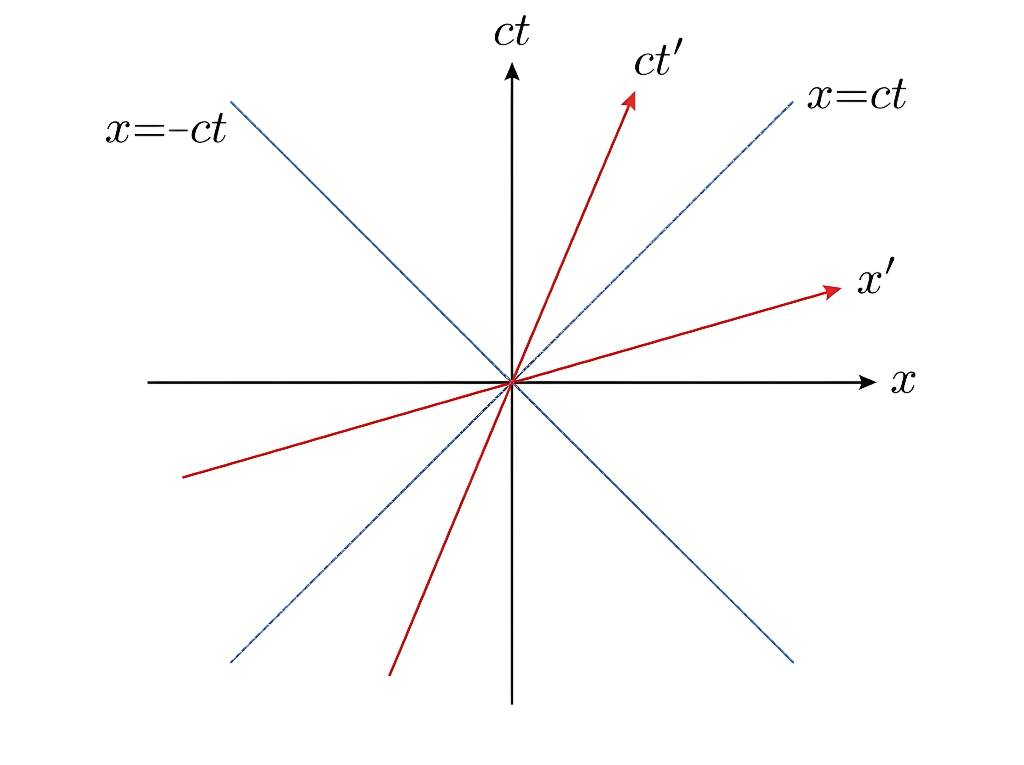
- The $x'$-axis is the line of simultaneity $ct' = 0$, which gives $-\beta x + ct = 0$, or $ct = \beta x$ (tilted upward with slope $\beta$ relative to the $x$-axis).
- The $ct'$-axis is the spatial origin $x' = 0$, which gives $x - \beta\,ct = 0$, or $x = \beta\,ct$ (tilted rightward with slope $\beta$ relative to the $ct$-axis).
Unlike a Euclidean rotation (where both axes rotate in the same sense), a Lorentz boost causes the $x'$ and $ct'$ axes to tilt symmetrically inward toward the invariant light line $x = ct$, each making an angle $\tan^{-1}(\beta)$ with its corresponding unprimed axis.
Part II: How the Magnetic Field Emerges from Special Relativity
Now let us see how the Lorentz transformation derived in Part I directly produces magnetism, an effect observable even when electron drift velocities in a wire are fractions of a millimeter per second!
1. Unit-Length Lorentz Contraction and Charge Density Rescaling
First, how does a unit length transform between frames? Consider a unit interval at rest in frame $S'$, extending from $x' = 0$ to $x' = 1$. Its two endpoints sweep out the parallel worldlines $x' = 0$ and $x' = 1$ in spacetime. You can see this live below: drag the blue dot on the graph to vary the relative velocity $\beta = v/c$, and watch the $(x', ct')$ axes tilt and the unit grid deform in real time (or open it in Desmos):
An observer in the laboratory frame $S$ measures the length of this moving interval by slicing across both worldlines simultaneously in $S$ (along the $x$-axis, where $ct = 0$). Substituting $x' = 1$ and $ct = 0$ into our Lorentz transformation $x' = \gamma\,(x - \beta\,ct)$ gives the intercept on the $x$-axis:
$$1 = \gamma\,(x - 0) \quad \Longrightarrow \quad x = \frac{1}{\gamma} = \sqrt{1 - \beta^2} = \sqrt{1 - \frac{v^2}{c^2}} < 1$$
Thus, one unit of proper length ($x' = 1$) in the moving frame $S'$ contracts to $1/\gamma$ units along the $x$-axis of frame $S$ (and any proper length $L_0$ contracts to $L = L_0 / \gamma$).
Consequence for Linear Charge Density: Suppose a line of charges has proper linear charge density $\lambda_0$ (charge per unit proper length) in its rest frame. Because electric charge is Lorentz-invariant while that unit proper length contracts from $1$ to $1/\gamma$ when moving at speed $v$, its charge is compressed into length $1/\gamma$, boosting the measured linear charge density by a factor of $\gamma$:
$$\lambda = \frac{\lambda_0}{1 / \gamma} = \gamma\,\lambda_0$$
2. The Laboratory Frame $S$: Pure Magnetism
Now consider a long, straight copper wire along the $x$-axis carrying a steady current $I$, and a test charge $+q$ at perpendicular distance $r$ moving parallel to the wire with velocity $\vec{v} = v\hat{x}$. Suppose the conduction electrons drift to the right with speed $v$ (matching the test charge), while the positive copper ions remain stationary in the laboratory frame $S$:
- The positive ions are at rest with linear charge density $\lambda_+ = +\lambda_0$.
- The conduction electrons move to the right at speed $v$ with linear charge density $\lambda_- = -\lambda_0$ (since the wire as a whole is electrically neutral in the lab frame).
Thus the net linear charge density in frame $S$ vanishes ($\lambda_{\text{net}} = \lambda_+ + \lambda_- = 0$). By Gauss's law, there is no electric field outside the wire in the lab frame ($\vec{E} = \vec{0}$). However, the moving electrons constitute a conventional current $I = -\lambda_- v = \lambda_0 v$ directed along $-\hat{x}$, which produces an azimuthal magnetic field $B = \frac{\mu_0 I}{2\pi r}$. The moving test charge $+q$ therefore experiences a radial magnetic Lorentz force toward the wire:
$$\vec{F}_B = q(\vec{v} \times \vec{B}), \qquad F_B = qvB = \frac{\mu_0 q v I}{2\pi r}$$
3. The Test Charge's Rest Frame $S'$: Pure Electrostatics via Lorentz Contraction
Now boost into the inertial frame $S'$ moving to the right at velocity $v$ alongside the test charge $+q$. In this frame, the test charge is at rest ($\vec{v}' = \vec{0}$). Because the magnetic Lorentz force $q(\vec{v}' \times \vec{B}')$ vanishes whenever $\vec{v}' = \vec{0}$, a stationary charge cannot feel any magnetic force! If the charge is still pulled toward the wire in frame $S'$, there must be an electrostatic field $\vec{E}'$ in $S'$.
Applying our unit-length contraction rule ($\lambda = \gamma\lambda_0$) to the ions and electrons in frame $S'$:
1. Positive Ions (now moving at $-v\hat{x}$ in $S'$): Because the positive ions were at rest in $S$ with proper density $\lambda_+ = \lambda_0$, in frame $S'$ their unit spacing contracts to $1/\gamma$, increasing their linear charge density by $\gamma$:
$$\lambda'_+ = \gamma \lambda_0$$
2. Conduction Electrons (now at rest in $S'$): In the lab frame $S$, the electrons were already moving at speed $v$, so their lab-frame density $\lambda_- = -\lambda_0$ was already contracted by $\gamma$ relative to their own rest frame $S'$. In $S'$, the electrons are at rest, so their unit spacing un-contracts, reducing the magnitude of their charge density by $\gamma$:
$$\lambda'_- = -\frac{\lambda_0}{\gamma}$$
4. Net Charge Density and the Relativistic Origin of $\mu_0$
Adding the two densities in the test charge's rest frame $S'$, we discover that the wire is no longer electrically neutral:
$$\lambda'_{\text{net}} = \lambda'_+ + \lambda'_- = \lambda_0 \left(\gamma - \frac{1}{\gamma}\right) = \lambda_0 \gamma \left(1 - \frac{1}{\gamma^2}\right) = \gamma \lambda_0 \beta^2 = \gamma \lambda_0 \frac{v^2}{c^2} > 0$$
By Gauss's law for an infinite line charge, this net linear charge density produces a radial electric field $E' = \frac{\lambda'_{\text{net}}}{2\pi \varepsilon_0 r}$ in frame $S'$, exerting a purely electrostatic force on our stationary test charge $+q$:
$$F'_E = q E' = \frac{q \lambda'_{\text{net}}}{2\pi \varepsilon_0 r} = \gamma \frac{q v (\lambda_0 v)}{2\pi \varepsilon_0 c^2 r}$$
Transforming this transverse force back to the laboratory frame $S$ via $F = F'_E / \gamma$, and substituting $I = \lambda_0 v$ together with $c^2 = \frac{1}{\mu_0 \varepsilon_0}$, the factor of $\gamma$ cancels and we recover:
$$F = \frac{F'_E}{\gamma} = \frac{q v I}{2\pi (\varepsilon_0 c^2) r} = q v \left(\frac{\mu_0 I}{2\pi r}\right) = q v B$$
What we call a "magnetic field" in the laboratory frame is simply the electrostatic Coulomb field of moving charges combined with Lorentz unit-length contraction and the invariance of $c$.
Part III: Why Photons Move at $c$ and Massive Particles Cannot
Having seen how Lorentz geometry governs spacetime and electrodynamics, let us answer the two central kinematic questions:
Why does a photon travel at the speed of light $c$? And why can no massive object ever reach or exceed $c$?
1. The Four-Momentum Identities
For a relativistic particle of rest mass $m$ moving with three-velocity $\vec{v}$, dimensionless speed $\beta = v/c$, and Lorentz factor $\gamma = (1 - \beta^2)^{-1/2}$, its total relativistic energy $E$ and relativistic three-momentum $\vec{p}$ are:
$$E = \gamma m c^2, \qquad \vec{p} = \gamma m \vec{v}$$
Combining these two relations eliminates $\gamma m$ and gives the velocity-momentum-energy identity:
$$\vec{p} c = \frac{E}{c} \vec{v} \qquad \text{(i)}$$
Meanwhile, squaring $E = \gamma m c^2$ and using $\gamma^2(1 - \beta^2) = 1$ yields the Lorentz-invariant energy-momentum dispersion relation:
$$E^2 = p^2 c^2 + m^2 c^4 \qquad \text{(ii)}$$
Taking the squared magnitude of Equation $\text{(i)}$ with $\beta = v/c$ gives:
$$p^2 c^2 = E^2 \beta^2 \qquad \text{(iii)}$$
2. The Master Velocity-Mass Equation
Substituting $E^2 = p^2 c^2 + m^2 c^4$ from $\text{(ii)}$ into $\text{(iii)}$ and dividing by $p^2 c^2$ (for any state carrying non-zero momentum $p > 0$) yields our master kinematic equation:
$$\beta^2 = \frac{p^2 c^2}{p^2 c^2 + m^2 c^4} = \frac{1}{1 + (mc/p)^2} \qquad \text{(iv)}$$
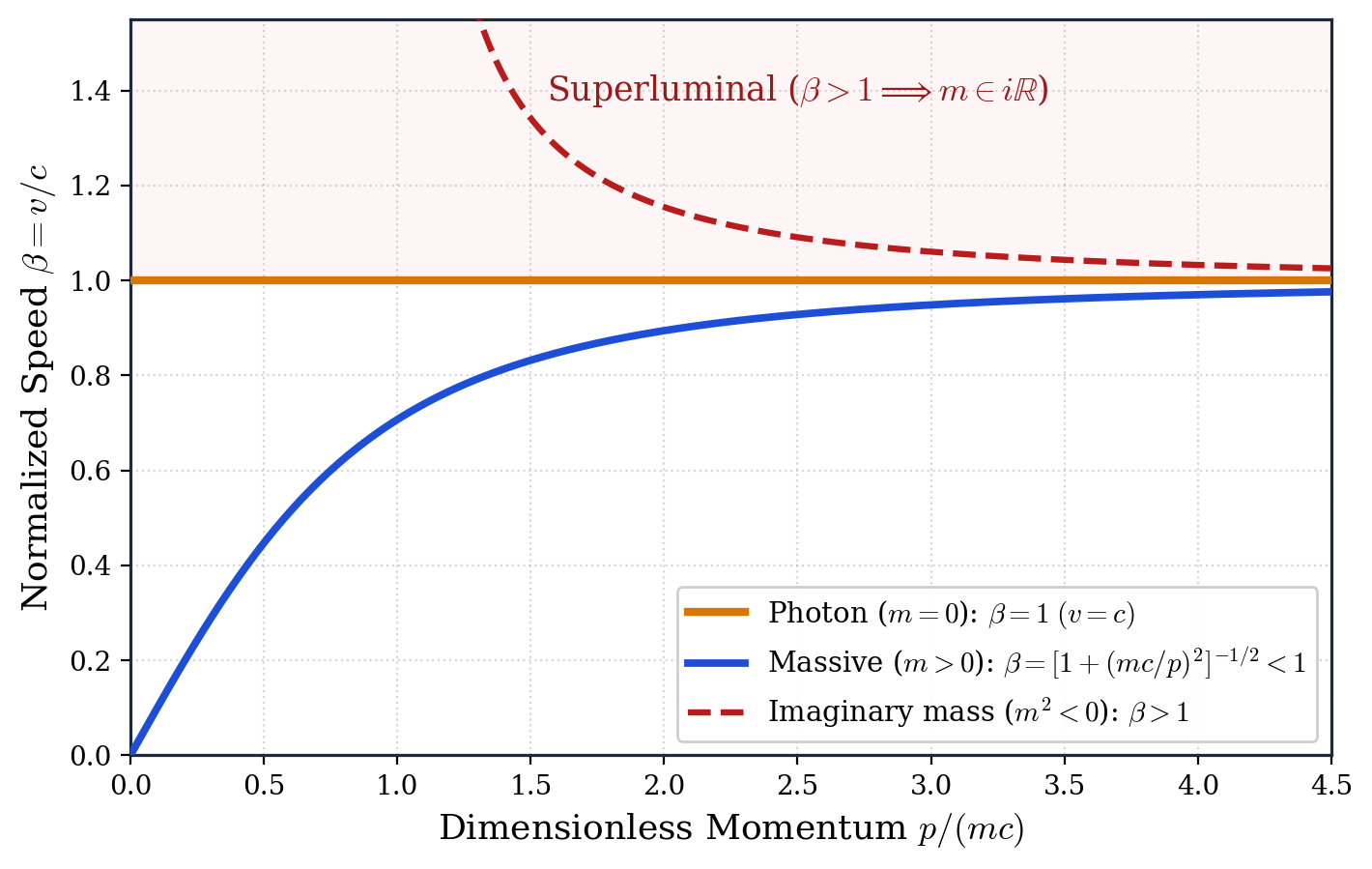
Every physical regime of relativistic motion follows immediately from inspecting $(mc/p)^2$ in Equation $\text{(iv)}$:
- Regime 1: Massless Particles ($m = 0$) and the Photon: For any real rest mass $m \in \mathbb{R}$, $(mc/p)^2 \ge 0$, so $\beta^2 \le 1$. Equality holds if and only if:
$$v = c \iff \beta = 1 \iff \frac{mc}{p} = 0 \iff m = 0$$
A particle with non-zero momentum travels at $c$ if and only if its rest mass vanishes ($m = 0$). In this massless limit ($m = 0, \beta = 1$), Equation $\text{(iii)}$ combined with $E = hf$ gives the photon's de Broglie momentum $p = E/c = h/\lambda$.
- Regime 2: Massive Particles ($m > 0$, Bradyons): Whenever $m > 0$ and $p < \infty$, $(mc/p)^2 > 0$, which strictly enforces:
$$\beta^2 = \frac{1}{1 + (mc/p)^2} < 1 \implies v < c$$
As $p \to \infty$, $\beta$ approaches $1$ only asymptotically; no massive particle can ever reach $v = c$.
- Regime 3: Superluminal Motion ($v > c$) and Tachyons: Achieving $\beta^2 > 1$ in Equation $\text{(iv)}$ requires $-1 < (mc/p)^2 < 0$, meaning $m^2 < 0$ ($m = i\mu$, a purely imaginary rest mass). In quantum field theory, $m^2 < 0$ signals an unstable potential maximum ($V''(\phi_0) < 0$) that triggers spontaneous symmetry breaking rather than faster-than-light particles. Because no physical particle has imaginary mass, nothing can travel faster than light: except "nothing" itself (empty space expanding beyond the Hubble horizon)!