Gödel’s Ontological Argument
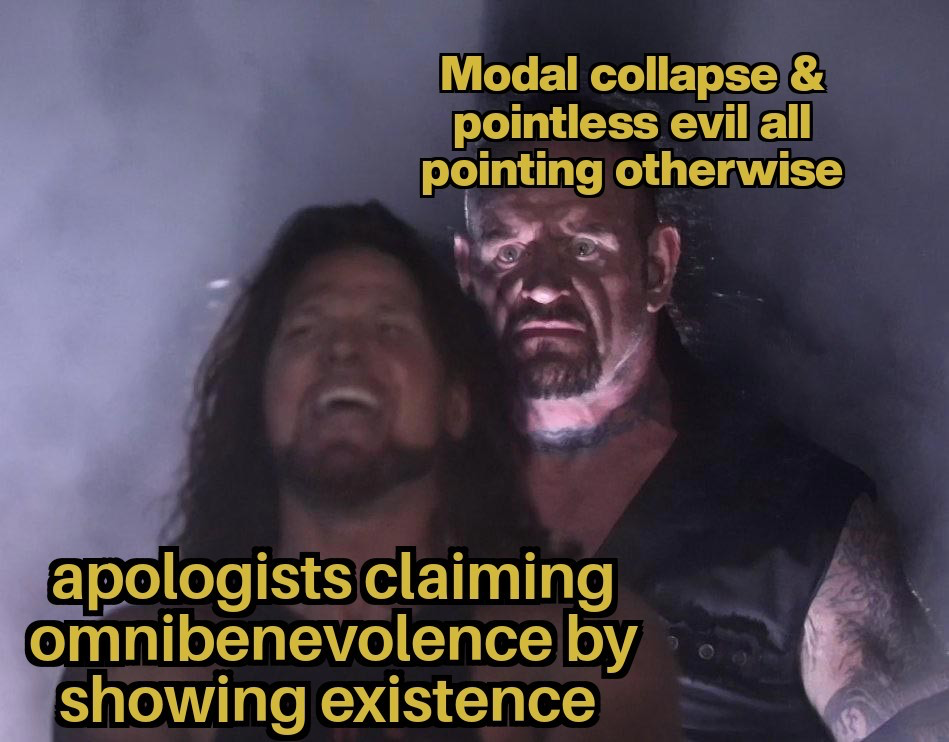
When moral critics argue that the suffering in our world points toward an indifferent or tyrannical creator, defenders of theism sometimes turn from theology to formal logic. If appeals to mysterious divine purposes cannot prove that God is good, perhaps a mathematical proof can settle the question in advance.
The most famous attempt is Kurt Gödel's modal ontological argument, later refined by Dana Scott. Gödel defines a "Godlike" being as an entity that possesses every "positive" property. At first glance, if loving concern for creatures counts as a positive property, a valid proof of a Godlike being seems to guarantee divine benevolence through pure deduction.
Yet a closer examination of the formal machinery shows that neither Scott's classic formulation nor later revisions of Gödel's proof establish divine benevolence. Worse still, when Scott's version is combined with traditional doctrines of retributive punishment, its logical consequences describe a system of government that is not benevolent, but tyrannical.
1. The Mechanics of Scott's Proof
Gödel's argument operates in S5 modal logic across "possible worlds," which represent alternative ways reality could have been rather than parallel physical universes. Within this modal framework, a statement is necessary if it holds in every accessible possible world, and possible if it holds in at least one. Accessibility specifies which worlds count as genuinely possible relative to the world under consideration.
Scott's formulation relies on five core axioms governing which properties qualify as "positive":
- Between any property and its negation, exactly one is positive.
- Any property necessarily implied by a positive property is itself positive.
- Being Godlike (possessing every positive property) is a positive property.
- Any property that is positive in one world remains positive in every accessible possible world.
- Necessary existence is a positive property.
Alongside these axioms, two definitions do the structural work: an essence is a property an individual possesses that necessarily implies all of its other properties, and necessary existence means that every essence of the individual is instantiated in every accessible possible world.
In S5 modal logic, where all worlds under consideration are mutually accessible, these assumptions validly yield the central theorem:
$$\Box\exists x\, G(x)$$
Here, $\Box$ means "necessarily" (in every accessible possible world), $\exists x$ means "there exists an individual $x$," and $G(x)$ means "$x$ is Godlike." Together, the formula states that necessarily, there exists a Godlike being. Automated theorem provers have verified that this deduction follows validly from Scott's axioms.
2. The Countermodel: Formal Positivity Is Not Moral Goodness
Logical validity guarantees that if the premises are true, the conclusion must be true, but it does not tell us what the word "positive" means. In ordinary English, calling a trait positive suggests moral value. Inside the formal proof, however, "positive" functions merely as an uninterpreted technical filter.
Let $\Gamma$ represent Scott's axioms and definitions, understood to hold in every world, and let $B(x)$ mean "$x$ is benevolent." To test whether $\Gamma$ logically guarantees benevolence, we can construct the smallest possible countermodel: a formal scenario in which every assumption in $\Gamma$ comes out true, but the proposed moral conclusion fails.
Imagine a model consisting of just one possible world, accessible to itself, containing a single individual. Suppose we classify a property as "positive" if and only if that single individual happens to possess it. Every axiom in $\Gamma$ holds in this tiny model:
- For any property, the individual either has it or lacks it (satisfying Axiom 1).
- Whatever necessarily follows from the individual's properties also belongs to that individual (satisfying Axiom 2).
- By construction, the individual possesses all positive properties, making it Godlike, so Godlikeness is positive (satisfying Axiom 3).
- Positivity never varies across worlds because there is only one world (satisfying Axiom 4).
- Every essence of the individual is instantiated in that single world, so it has necessary existence, which is therefore positive (satisfying Axiom 5).
Now consider the predicate $B(x)$. Because $\Gamma$ contains no moral axioms governing what benevolence requires, we are free to stipulate that the lone individual in our model lacks benevolence entirely, while every formal assumption of the proof remains satisfied. We can equally stipulate that the individual possesses benevolence.
Using $\wedge$ for "and," $\models$ to mean "logically entails in every S5 model," and $\not\models$ for "does not entail," we arrive at a strict logical boundary:
$$\Gamma \models \Box\exists x\, G(x), \qquad \Gamma \not\models \Box\exists x\,\bigl(G(x) \wedge B(x)\bigr)$$
The first relation states that necessary Godlike existence follows from Scott's assumptions. The second states that necessary benevolent Godlike existence does not. This minimal model does not depict an actual cruel creator ruling over suffering creatures, since it contains only one individual. What it proves is that the axioms alone cannot distinguish between a caring deity and an indifferent one. A defender can add an extra axiom asserting that benevolence is positive, but simply attaching an approving label does not discharge the philosophical burden of defending that claim.
3. Modal Collapse and the Injustice of Retribution
Scott's assumptions carry a second, severe consequence for traditional theology. As Jordan Howard Sobel demonstrated (and computer-assisted formalizations have confirmed), Scott's proof entails modal collapse:
$$p \longrightarrow \Box p$$
Here, $\to$ means "implies." Because the Godlike being's essence locks in every property it has in the actual world (including relational facts about what happens here), and because a Godlike being exists in every possible world, every true proposition $p$ becomes necessarily true across all possible worlds. Nothing could have gone differently.
First, modal collapse exposes how morally empty formal "positivity" really is. If children die in an earthquake today, the Godlike being possesses the relational property of coexisting with that tragedy. Scott's system therefore classifies "being such that children died in that earthquake" as a positive property, even though there is nothing morally good about their deaths.
Second, modal collapse destroys the foundation of retributive punishment. Let $p$ mean that a human being committed a wrongful act. Using $\neg$ for "not" and $\Diamond$ for "possibly," an actual offense follows an inescapable deductive chain:
$$p \longrightarrow \Box p \longrightarrow \neg\Diamond\neg p$$
If $p$ is true, modal collapse makes $p$ necessary ($\Box p$), which is logically equivalent to saying that it was not possible for $p$ to be false ($\neg\Diamond\neg p$). There is no accessible possible world in which the offender refrained from doing wrong. Nor can we rescue moral freedom by tracing responsibility back to an earlier character-forming decision, because every earlier decision was equally necessary.
Now suppose we combine Scott's Godlike being with the theological doctrine that the creator inflicts severe postmortem suffering (such as hell) because wrongdoers deserve it. Unlike restraint (which protects others), restitution (which repairs a victim's loss), or rehabilitation (which reforms future conduct), basic punitive desert imposes suffering simply as an earned burden for past wrongdoing.
Fairness requires control before imposing such a burden: a person deserves retributive suffering only if they had a genuine opportunity to avoid the offense for which they are punished. Some philosophers, following Harry Frankfurt, argue that acting from one's own motives can ground moral responsibility even without alternative possibilities. Requiring an opportunity to avoid wrongdoing is therefore a substantive moral commitment rather than a theorem of logic. Yet any competing account must still explain what makes an added burden of suffering fairly earned when the offender's entire history excluded every route away from the offense.
For anyone who accepts that fair retribution requires the ability to do otherwise, let $C$ mean that a person is culpable in the sense required for basic punitive desert, and let $A$ mean that the person had a genuine opportunity to avoid the wrongdoing. The deduction is immediate:
$$C \longrightarrow A, \qquad \neg A \qquad \Longrightarrow \qquad \neg C$$
The first premise expresses the moral requirement of fairness. The second follows directly from modal collapse ($\neg\Diamond\neg p$). The conclusion states that no human offender possesses the culpability required to deserve retributive suffering. If the creator nevertheless subjects people to severe suffering as deserved retribution, the punishment lacks the very desert invoked to justify it. A government that systematically inflicts severe, undeserved punishment is tyrannical, and it is incompatible with perfect benevolence.
An apologist might point to a logical symmetry: under modal collapse, God also lacked alternative possibilities ($\neg\Diamond\neg q$ for any divine action $q$). Fairness requires respecting that symmetry. If lacking alternatives removes retributive blameworthiness, we cannot absolve human beings on that ground while demanding that God be punished for failing to act otherwise. Yet excusing a ruler from retributive blame does not make that ruler's regime benevolent. Whether an administrator deserves punishment and whether that administrator's government is oppressive are two distinct questions. Necessity neither makes victims culpable nor turns their torment into loving care.
4. Do Revised Versions of Gödel's Proof Save Benevolence?
To escape modal collapse, logicians such as C. Anthony Anderson (1990) and Melvin Fitting (2002) formulated revised versions of Gödel's argument. Anderson weakens the first axiom so that while a property and its negation cannot both be positive, some properties can be neither positive nor negative (leaving room for logically and morally indifferent facts). Fitting restricts how positivity applies to properties across possible worlds so that contingent facts about the world do not get absorbed into the Godlike being's necessary essence.
Adopting Anderson's or Fitting's revision prevents modal collapse (allowing $p$ without $\Box p$), but it leaves the defender of divine benevolence caught in a two-part dilemma:
- (I) The formal gap remains untouched: Neither Anderson's nor Fitting's system contains moral axioms governing what "positive" means. In Anderson's framework, we can construct a model in which moral concern for creatures falls into the indifferent category (neither positive nor negative), while properties related to power or agency count as positive. Just as in Scott's version, the formal axioms yield a Godlike being without entailing $B(x)$.
- (II) Restoring open alternatives removes the excuse of necessity: To whatever extent these revisions succeed in restoring genuinely open alternative possibilities ($\Diamond\neg p$), they restore open alternatives to the creator as well. That brings the theist straight back to the core moral challenge: if alternative arrangements were genuinely available, why would a perfectly benevolent creator knowingly permit unending conscious misery rather than choosing an adequate, less harmful alternative?
Whether one adopts a formal proof that collapses alternatives or a revised proof that preserves them, modal logic offers no shelter from moral evaluation. If alternatives are closed, retributive punishment is undeserved. If alternatives are open, permitting preventable agony when an adequate alternative is available remains open to condemnation. Neither supreme power nor a formal theorem can turn tyranny into justice.