From Peano Axioms to ℝ and ℂ: Constructing the Number System

Whether $0$ is considered a natural number is purely a matter of convention. Throughout this article, we adopt the standard foundational convention:
$$\mathbb{N} := \{0, 1, 2, 3, \dots\}$$
This raises a foundational question: how do we rigorously construct $\mathbb{N}$ from scratch, and how do we climb all the way from $\mathbb{N}$ through $\mathbb{Z}$, $\mathbb{Q}$, and $\mathbb{R}$ to the complex field $\mathbb{C}$?
1. Constructing $\mathbb{N}$ via the Peano Axioms
The classic axiomatization of the natural numbers is given by the Peano Axioms. Rather than listing all five axioms at once, it is much more illuminating to introduce them one by one and see what breaks when any single axiom is omitted.
Axiom (a) & Axiom (b): Starting Point and Successors
- Axiom (a): $0 \in \mathbb{N}$.
- Axiom (b): If $n \in \mathbb{N}$, then its successor $n^{++} \in \mathbb{N}$.
We define the familiar numerals as abbreviations for repeated successors: $1 := 0^{++}$, $2 := 1^{++}$, $3 := 2^{++}$, and so on.
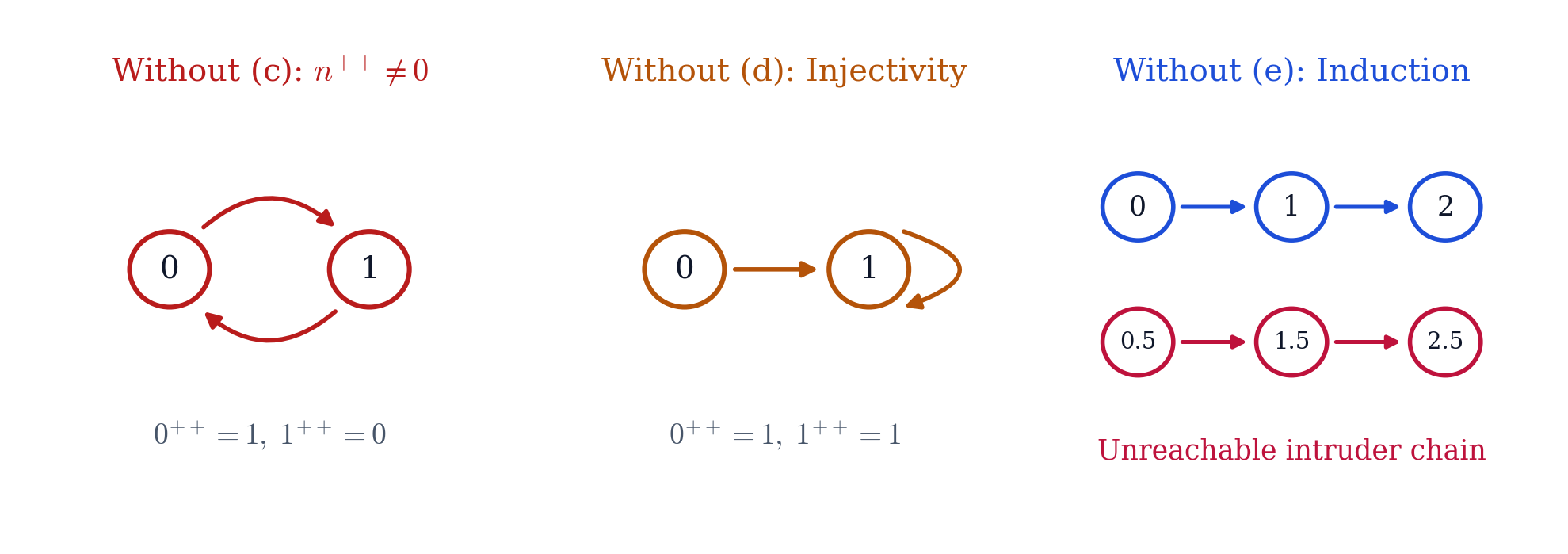
Why (a) and (b) are not enough: Nothing in these two rules prevents the successor operation from looping back to $0$. For instance, the two-element set $\mathbb{N} = \{0, 1\}$ with
$$0^{++} = 1, \qquad 1^{++} = 0$$
satisfies both (a) and (b)! To forbid cycles returning to $0$, we need a third axiom:
Axiom (c): $0$ Is Not a Successor
- Axiom (c): For all $n \in \mathbb{N}$, $n^{++} \neq 0$.
This prevents the chain from wrapping back around to $0$.
Why (a), (b), and (c) are still not enough: Consider again the two-element set $\mathbb{N} = \{0, 1\}$, but now define:
$$0^{++} = 1, \qquad 1^{++} = 1$$
Here nothing maps to $0$, so Axiom (c) is satisfied, yet the chain gets stuck at $1$ forever! To prevent two distinct numbers from collapsing onto the same successor, we require the successor map to be injective (one-to-one):
Axiom (d): Injectivity of the Successor Map
- Axiom (d): For all $n, m \in \mathbb{N}$, if $n^{++} = m^{++}$, then $n = m$.
Now $0^{++} = 1$ and $1^{++} = 1$ is impossible because $0 \neq 1$. Together, Axioms (a) through (d) force $\mathbb{N}$ to be an infinite set.
Why even (a) through (d) are not enough: Even an infinite set satisfying (a) through (d) can contain "uninvited guests" that cannot be reached from $0$ by repeated successors! For example, suppose someone claims:
$$\tilde{\mathbb{N}} = \{0, 0.5, 1, 1.5, 2, 2.5, \dots\}$$
with $x^{++} = x + 1$. This set contains $0$, is closed under $^{++}$, never maps back to $0$, and has an injective successor map. Yet the half-integers $0.5, 1.5, 2.5, \dots$ form a separate, parallel chain hiding inside the set that is completely unreachable starting from $0$.
To lock out every such rogue element, we introduce the fifth and final axiom:
Axiom (e): Principle of Mathematical Induction
- Axiom (e): Let $P(n)$ be any property pertaining to $n$. If $P(0)$ is true, and whenever $P(n)$ is true it follows that $P(n^{++})$ is also true, then $P(n)$ is true for all $n \in \mathbb{N}$.
Watch how Induction immediately expels the half-integers: define the predicate
$$P(n) :\equiv \text{"}n\text{ is not a half-integer."}$$
- Base case: $P(0)$ is clearly true.
- Inductive step: If $n$ is not a half-integer, then $n + 1$ is not a half-integer either, so $P(n) \implies P(n^{++})$.
By Axiom (e), $P(n)$ must hold for every $n \in \mathbb{N}$. Since $P(0.5)$ is false, $0.5$ cannot belong to $\mathbb{N}$!
2. Von Neumann Ordinals and the Axiom of Infinity
The Peano axioms specify how $\mathbb{N}$ behaves, but can we explicitly build a concrete model of $\mathbb{N}$ out of pure sets? My favorite construction is due to John von Neumann, who defined each natural number as the set of all preceding natural numbers via the successor operation:
$$x^{++} := x \cup \{x\}$$
Starting with $0 := \varnothing$ (the empty set), every natural number emerges purely from braces:
$$\begin{aligned} 0 &:= \varnothing \\ 1 &:= 0^{++} = \varnothing \cup \{\varnothing\} = \{\varnothing\} \\ 2 &:= 1^{++} = \{\varnothing, \{\varnothing\}\} = \{0, 1\} \\ 3 &:= 2^{++} = \{\varnothing, \{\varnothing\}, \{\varnothing, \{\varnothing\}\}\} = \{0, 1, 2\} \end{aligned}$$
Notice that the cardinality (number of elements) of the set $n$ is literally $n$!
Here is the catch illustrated in the meme below: using the elementary axioms of Zermelo-Fraenkel (ZF) set theory (Empty Set, Pairing, and Union), we can construct any individual finite ordinal $0, 1, 2, \dots, n$. However, a finite sequence of set operations can never gather all of them into a single completed set $\mathbb{N}$.
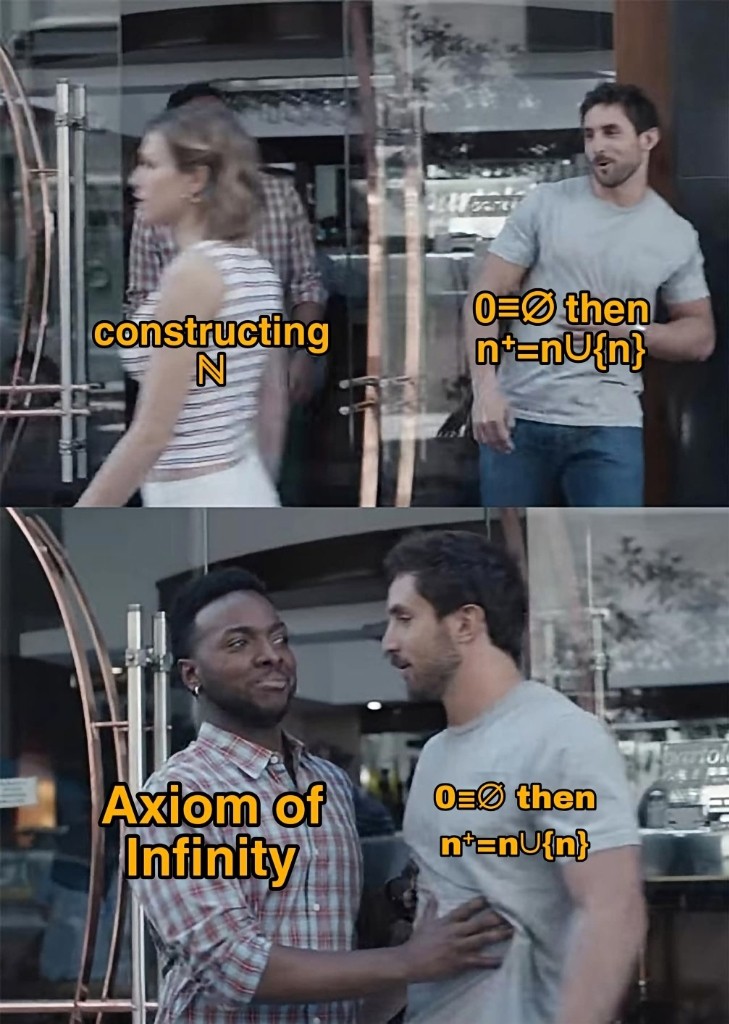
To guarantee that the entire infinite collection $\mathbb{N} = \{0, 1, 2, \dots\}$ exists as a set, ZF must postulate the Axiom of Infinity: there exists an inductive set containing $\varnothing$ that is closed under $x \mapsto x \cup \{x\}$.
3. Constructing $\mathbb{Z}$ and $\mathbb{Q}$ via Equivalence Classes
Once we have $(\mathbb{N}, +, \times)$, how do we construct negative numbers and fractions without assuming subtraction or division beforehand? The secret is equivalence classes of ordered pairs.
Step 1: Constructing the Integers $\mathbb{Z}$ from $\mathbb{N} \times \mathbb{N}$
In $\mathbb{N}$, an equation like $x + 3 = 2$ has no solution because $2 - 3$ does not exist in $\mathbb{N}$. To build the integers $\mathbb{Z}$ using only natural numbers and $+$, we represent every integer as an ordered pair $(a, b) \in \mathbb{N} \times \mathbb{N}$, which we intuitively think of as the difference $a - b$.
Since $a - b = c - d \iff a + d = b + c$, we can state when two pairs represent the same integer using only addition in $\mathbb{N}$:
$$(a, b) \sim (c, d) \iff a + d = b + c$$
The integers are the equivalence classes $\mathbb{Z} := (\mathbb{N} \times \mathbb{N}) / {\sim}$:
- Zero: $0_{\mathbb{Z}} = [(0, 0)] = \{(0, 0), (1, 1), (2, 2), \dots\}$
- Positive integers: $+n = [(n, 0)] = \{(n, 0), (n+1, 1), (n+2, 2), \dots\}$
- Negative integers: $-n = [(0, n)] = \{(0, n), (1, n+1), (2, n+2), \dots\}$
Step 2: Constructing the Rationals $\mathbb{Q}$ from $\mathbb{Z} \times (\mathbb{Z} \setminus \{0\})$
In $\mathbb{Z}$, we can subtract freely, but $2x = 1$ still has no solution. To build fractions $p/q$ without already having division, we take ordered pairs $(p, q) \in \mathbb{Z} \times (\mathbb{Z} \setminus \{0\})$ and define equivalence via cross-multiplication:
$$(p, q) \sim (r, s) \iff p \cdot s = q \cdot r$$
The rational numbers are the equivalence classes $\mathbb{Q} := \left(\mathbb{Z} \times (\mathbb{Z} \setminus \{0\})\right) / {\sim}$, with addition $[(p, q)] + [(r, s)] = [(ps + qr,\, qs)]$ and multiplication $[(p, q)] \cdot [(r, s)] = [(pr,\, qs)]$.
4. Why $\mathbb{Q}$ Is Incomplete: A Gap at $\sqrt{2}$
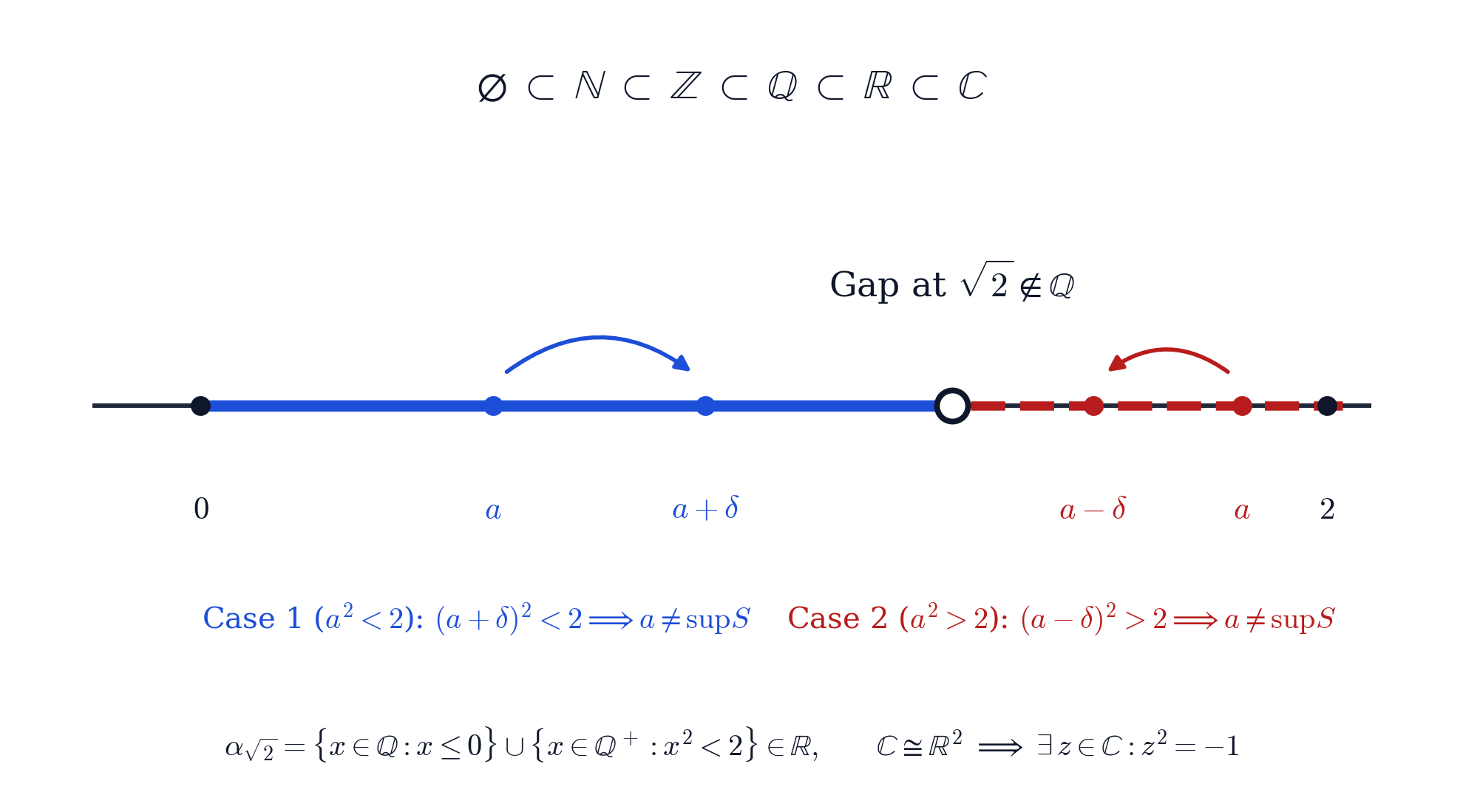
Equipped with $+$ and $\times$, $(\mathbb{Q}, +, \times, <)$ forms an ordered field. Yet $\mathbb{Q}$ still has holes: a nonempty subset of $\mathbb{Q}$ can be bounded above in $\mathbb{Q}$ without having a supremum (least upper bound) in $\mathbb{Q}$.
Consider the nonempty rational set:
$$S = \{x \in \mathbb{Q} : x > 0 \text{ and } x^2 < 2\} \neq \varnothing$$
Clearly $\inf S = 0 \in \mathbb{Q}$, and $S$ is bounded above by $2$. Suppose for contradiction that $S$ had a least upper bound $a = \sup S \in \mathbb{Q}$ (with $0 < a < 2$):
Case 1: $a^2 < 2$
If $a^2 < 2$, we can find a small positive rational step $\delta \in \mathbb{Q}$ ($0 < \delta \le 1$) such that $(a + \delta)^2 < 2$ still holds. Since $a < 2$ and $\delta \le 1$:
$$(a + \delta)^2 = a^2 + \delta(2a + \delta) < a^2 + \delta(2 \times 2 + 1) = a^2 + 5\delta$$
Choosing $\delta = \min\!\left(1,\, \frac{2 - a^2}{5}\right) \in \mathbb{Q}^+$ gives $(a + \delta)^2 < a^2 + 5\delta \le 2$. Thus $a + \delta \in S$ and $a + \delta > a$, contradicting that $a$ is an upper bound of $S$!
Case 2: $a^2 > 2$
If $a^2 > 2$, choosing $\delta = \frac{a^2 - 2}{2a} \in \mathbb{Q}^+$ gives $a - \delta > 0$ and
$$(a - \delta)^2 = a^2 - 2a\delta + \delta^2 > a^2 - 2a\left(\frac{a^2 - 2}{2a}\right) = 2$$
Thus $a - \delta < a$ is already an upper bound for $S$, contradicting that $a$ is the least upper bound ($\sup S$)!
Therefore $\sup S$ would have to satisfy $a^2 = 2$ ($a = \sqrt{2} \notin \mathbb{Q}$), proving that $\sup S$ does not exist in $\mathbb{Q}$.
5. Constructing the Real Numbers $\mathbb{R}$ via Dedekind Cuts
How do we fill every gap in $\mathbb{Q}$ to construct the complete ordered field $\mathbb{R}$? Notice first that we cannot build $\mathbb{R}$ as a simple quotient of finite pairs like $\mathbb{N} \times \mathbb{N}$ because $\mathbb{N} \times \mathbb{N}$ and $\mathbb{Q}$ are countable ($\aleph_0$), whereas $\mathbb{R}$ is uncountable ($2^{\aleph_0}$). Instead, we step up from pairs of rationals to subsets of $\mathbb{Q}$!
Since $\mathbb{Q}$ has a hole at $\sqrt{2}$, Richard Dedekind's brilliant idea (1872) was to identify each real number with the set of all rational numbers strictly to its left. Formally, a Dedekind cut is a subset $\alpha \subset \mathbb{Q}$ satisfying three simple rules:
- Nontrivial: $\alpha \neq \varnothing$ and $\alpha \neq \mathbb{Q}$.
- Closed downward: If $p \in \alpha$ and $q \in \mathbb{Q}$ with $q < p$, then $q \in \alpha$.
- No greatest element: For every $p \in \alpha$, there exists $r \in \alpha$ with $p < r$.
Look how naturally our gap set $S$ turns into the real number $\sqrt{2} \in \mathbb{R}$:
$$\alpha_{\sqrt{2}} := \{x \in \mathbb{Q} : x \le 0\} \cup \{x \in \mathbb{Q} : x > 0 \text{ and } x^2 < 2\}$$
Ordering on cuts is just set inclusion ($\alpha \le \beta \iff \alpha \subseteq \beta$), with the zero cut given by $0_{\mathbb{R}} := \{q \in \mathbb{Q} : q < 0\}$. Dedekind Completeness becomes effortless: for any nonempty family $\mathcal{F}$ of cuts bounded above, its least upper bound ($\sup \mathcal{F}$) in $\mathbb{R}$ is simply their set union $\bigcup_{\alpha \in \mathcal{F}} \alpha$!
Arithmetic on Dedekind Cuts ($+$ and $\cdot$)
To make $\mathbb{R}$ an ordered field, how do we add and multiply cuts?
- Addition is completely natural: we add every rational in $\alpha$ to every rational in $\beta$:
$$\alpha + \beta := \{p + q : p \in \alpha,\, q \in \beta\}$$
- Multiplication has a famous subtlety: we cannot simply define $\alpha \cdot \beta$ as $\{p \cdot q : p \in \alpha, q \in \beta\}$, because every cut contains arbitrarily large negative rationals (e.g., $-1000 \in \alpha, -1000 \in \beta$), whose product $+10^6$ would make the set unbounded above! Instead, for positive cuts ($\alpha > 0_{\mathbb{R}}$ and $\beta > 0_{\mathbb{R}}$), we multiply only their positive elements and attach the negative rationals to keep the cut closed downward:
$$\alpha \cdot \beta := \{q \in \mathbb{Q} : q \le 0\} \cup \{p \cdot q : p \in \alpha,\, q \in \beta \text{ with } p > 0,\, q > 0\}$$
(with multiplication for negative cuts then defined by the standard sign rules, e.g., $\alpha \cdot \beta = -((-\alpha) \cdot \beta)$ when $\alpha < 0_{\mathbb{R}} < \beta$). Under this definition, notice that for our cut $\alpha_{\sqrt{2}}$, multiplying positive rationals $p, q > 0$ with $p^2 < 2$ and $q^2 < 2$ yields $\alpha_{\sqrt{2}} \cdot \alpha_{\sqrt{2}} = \{x \in \mathbb{Q} : x < 2\} = 2_{\mathbb{R}}$!
6. From $\mathbb{R}$ to $\mathbb{C}$: Why Any Field Structure on $\mathbb{R}^2$ Forces $z^2 = -1$
In the complete ordered field $\mathbb{R}$, every nonnegative number has a square root, yet the polynomial $z^2 + 1 = 0$ still has no root because $x^2 \ge 0$ for all $x \in \mathbb{R}$. Rather than inventing an "imaginary" symbol $i = \sqrt{-1}$ by fiat, we can ask a much more structural question: if we view $\mathbb{C} \cong \mathbb{R}^2$ as a 2-dimensional vector space over $\mathbb{R}$ and equip it with any valid field multiplication compatible with its vector-space operations, must there automatically exist an element $z \in \mathbb{R}^2$ satisfying $z^2 = -1$?
Let us prove this directly from the vector-space and field axioms:
Step 1: Basis Decomposition in $\mathbb{R}^2$
View $\mathbb{C} \cong \mathbb{R}^2$ as a 2-dimensional $\mathbb{R}$-vector space spanned by the multiplicative identity $\mathbf{1}$ (which spans the real axis) and any second linearly independent vector $\mathbf{e} \notin \operatorname{span}\{\mathbf{1}\}$:
$$\mathbb{R}^2 = \operatorname{span}\{\mathbf{1},\, \mathbf{e}\}$$
Consider an arbitrary vector $z \in \mathbb{R}^2$ that does not lie on the real ($\mathbf{1}$) axis:
$$z = x \cdot \mathbf{1} + y \cdot \mathbf{e}, \qquad x, y \in \mathbb{R}, \quad y \neq 0$$
Step 2: Squaring $z$ Using Closure of Multiplication
By bilinearity and commutativity of the field multiplication on $\mathbb{R}^2$:
$$z^2 = x^2 \cdot \mathbf{1} + y^2 \cdot \mathbf{e}^2 + 2xy \cdot \mathbf{e}$$
Since $\mathbb{R}^2$ is closed under multiplication, $\mathbf{e}^2 \in \mathbb{R}^2$ must itself be a unique real linear combination of the basis vectors $\{\mathbf{1}, \mathbf{e}\}$:
$$\mathbf{e}^2 = a \cdot \mathbf{1} + b \cdot \mathbf{e} \qquad \text{for some } a, b \in \mathbb{R}$$
Substituting $\mathbf{e}^2$ into the expansion of $z^2$ gives:
$$z^2 = (x^2 + ay^2) \cdot \mathbf{1} + (by^2 + 2xy) \cdot \mathbf{e}$$
Step 3: Eliminating the $\mathbf{e}$-Component
Because $y \neq 0$, we can choose the real coordinate $x = -\frac{by}{2} \in \mathbb{R}$ so that the coefficient of $\mathbf{e}$ vanishes ($by^2 + 2xy = by^2 - by^2 = 0$). With this choice of $x$, $z^2$ collapses purely onto the $\mathbf{1}$-axis:
$$z^2 = \left(x^2 + ay^2\right) \cdot \mathbf{1} = \left(\frac{b^2 y^2}{4} + ay^2\right) \cdot \mathbf{1} = \left(a + \frac{b^2}{4}\right) y^2 \cdot \mathbf{1}$$
Step 4: Why $a + \frac{b^2}{4}$ Must Be Strictly Negative
Every real number $a + \frac{b^2}{4} \in \mathbb{R}$ can be written as either $+c^2$ or $-c^2$ for some $c \ge 0$:
- Suppose $a + \frac{b^2}{4} = c^2 \ge 0$: Then
$$z^2 = c^2 y^2 \cdot \mathbf{1} = (cy \cdot \mathbf{1})^2 \implies (z - cy \cdot \mathbf{1})(z + cy \cdot \mathbf{1}) = 0$$
Because a field has no zero divisors, this forces $z = \pm cy \cdot \mathbf{1}$. Contradiction! By construction, $z = -\frac{by}{2}\mathbf{1} + y\mathbf{e}$ has $y \neq 0$, so $z$ does not align with the real ($\mathbf{1}$) axis.
- Therefore, $a + \frac{b^2}{4} = -c^2 < 0$ (with $c > 0$): Now simply choose $y = \frac{1}{c}$ (and $x = -\frac{b}{2c}$). Then the vector
$$z = -\frac{b}{2c} \cdot \mathbf{1} + \frac{1}{c} \cdot \mathbf{e} \in \mathbb{R}^2$$
satisfies:
$$z^2 = -c^2 \cdot \left(\frac{1}{c}\right)^2 \cdot \mathbf{1} = -\mathbf{1}$$
$$\therefore \quad \exists\, z \in \mathbb{C} \text{ such that } z^2 = -1.$$
Thus, the existence of $i$ (with $i^2 = -1$) is not an arbitrary invention: any way of turning the 2D real plane $\mathbb{R}^2$ into a field over $\mathbb{R}$ inevitably produces a square root of $-1$ and yields a field isomorphic to $\mathbb{C}$!