Conservative Forces, Potential Energy, and Noether's Theorem
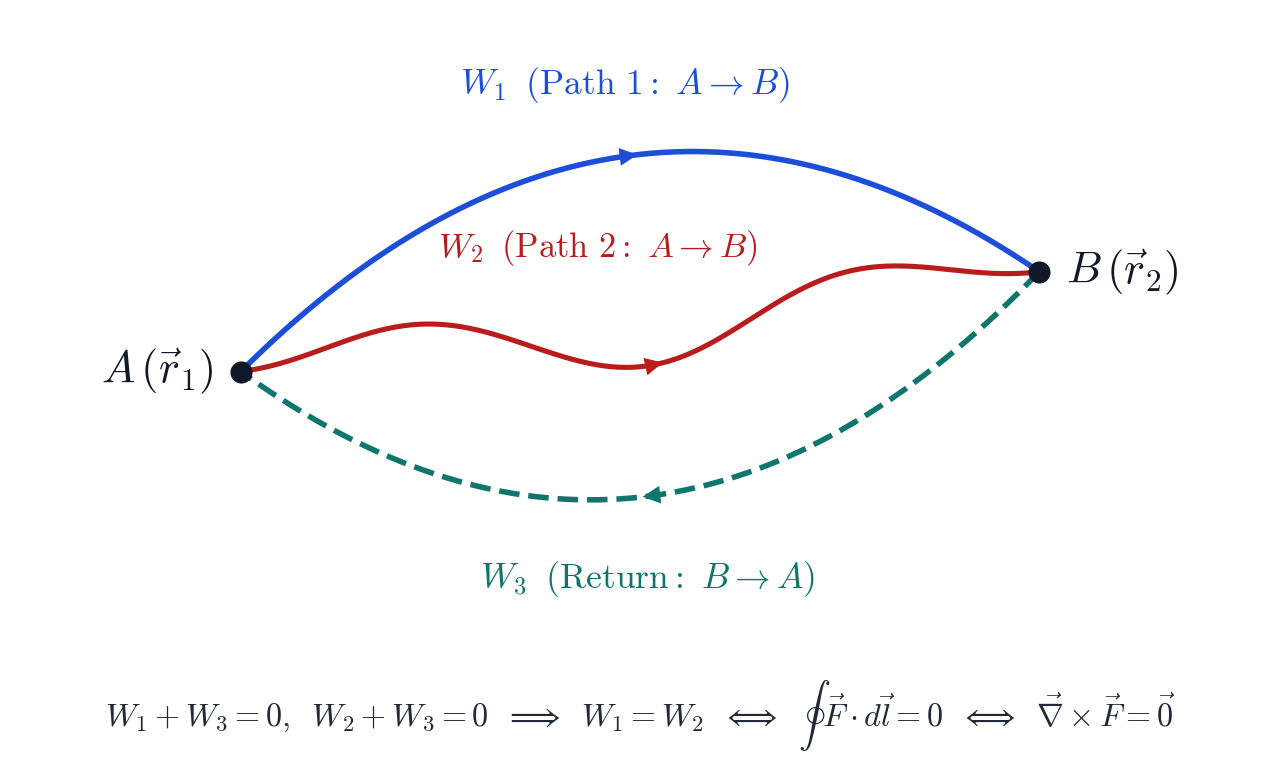
A conservative force does the same work between two points whichever path you take. That simple fact leads to a potential, a curl test, and a question for Noether: what makes energy stay constant?
1. Path Independence and the Existence of a Potential
We begin with a smooth, time-independent force field $\vec{F}(\vec{r})$ on a connected region and a particle of constant mass $m$ in an inertial frame.
Step 1: Closed Loops vs. Endpoint-Only Work
In the diagram above, a particle can travel from point $A\,(\vec{r}_1)$ to point $B\,(\vec{r}_2)$ along two distinct paths (Path 1 with work $W_1$, or Path 2 with work $W_2$), and return from $B$ back to $A$ along a common third path (Return Path 3 with work $W_3$).
Because the round trip $A \to B \to A$ forms a closed loop returning the particle to its exact starting point $A$, the total work around either closed loop vanishes:
$$W_1 + W_3 = 0 \qquad \text{(i)}$$
$$W_2 + W_3 = 0 \qquad \text{(ii)}$$
Subtracting $\text{(ii)}$ from $\text{(i)}$ immediately gives:
$$W_1 = W_2$$
Conversely, if the work between any two points depends only on the endpoints, then a closed loop from $A$ back to $A$ must do the same work as staying at $A$: zero.
Step 2: Constructing the Scalar Potential $V(\vec{r})$
Because the work done between $A$ and $B$ depends only on the endpoints, we can construct a scalar state function, the potential energy $V(\vec{r})$, explicitly. Choose a reference point $\vec{r}_0$, assign it an arbitrary reference value $V(\vec{r}_0)$, and define:
$$V(\vec{r}) := V(\vec{r}_0) - \int_{\vec{r}_0}^{\vec{r}} \vec{F} \cdot d\vec{\ell} \qquad \text{(iii)}$$
Path independence guarantees that this line integral is completely unambiguous. Evaluating the potential difference between $A$ and $B$ immediately gives:
$$V(B) - V(A) = -\int_A^B \vec{F} \cdot d\vec{\ell} = -W_{A \to B}$$
Only potential differences determine work, so shifting $V(\vec{r}) \mapsto V(\vec{r}) + C$ by a constant changes no physical force. Along an infinitesimal displacement $d\vec{r} = \langle dx, dy, dz \rangle$, Equation $\text{(iii)}$ gives $dV = -\vec{F} \cdot d\vec{r}$, while the multivariable chain rule gives:
$$dV = \frac{\partial V}{\partial x}dx + \frac{\partial V}{\partial y}dy + \frac{\partial V}{\partial z}dz = \vec{\nabla}V \cdot d\vec{r}$$
Since $-\vec{F} \cdot d\vec{r} = \vec{\nabla}V \cdot d\vec{r}$ holds for every displacement direction $d\vec{r}$, we obtain:
$$\boxed{\vec{F}(\vec{r}) = -\vec{\nabla}V(\vec{r})} \qquad \text{(iv)}$$
2. Stokes' Theorem and the Role of the Domain ($\vec{\nabla} \times \vec{F} = \vec{0}$)
How can we test whether a given force field $\vec{F}(\vec{r})$ is conservative without integrating along every possible path?
Step 1: Why Every Smooth Conservative Force Is Curl-Free
For a conservative force, the circulation around every closed contour $C$ vanishes:
$$W_{\text{loop}} = \oint_C \vec{F} \cdot d\vec{\ell} = 0 \qquad \text{(v)}$$
By Stokes' Theorem, for any oriented smooth surface $S$ bounded by $C = \partial S$ on which $\vec{F}$ is smooth, the circulation around the boundary equals the flux of the curl through the surface:
$$\oint_C \vec{F} \cdot d\vec{\ell} = \iint_S (\vec{\nabla} \times \vec{F}) \cdot d\vec{S} \qquad \text{(vi)}$$
Combining $\text{(v)}$ and $\text{(vi)}$, since $\iint_S (\vec{\nabla} \times \vec{F}) \cdot d\vec{S} = 0$ must hold for arbitrarily small surfaces around every point, the integrand itself must vanish everywhere:
$$\vec{\nabla} \times \vec{F} = \vec{0} \qquad \text{(vii)}$$
Thus, every smooth conservative force field is irrotational (curl-free). This also follows directly from $\vec{F} = -\vec{\nabla}V$, since the curl of any smooth gradient field vanishes identically ($\vec{\nabla} \times (-\vec{\nabla}V) = \vec{0}$).
Step 2: Why the Converse Requires a Simply Connected Domain
Does $\vec{\nabla} \times \vec{F} = \vec{0}$ automatically guarantee that $\vec{F} = -\vec{\nabla}V$? The converse requires a topological condition on the domain. On a simply connected region (where every closed loop can be continuously shrunk to a point without leaving the region), every smooth curl-free field is guaranteed to have a global scalar potential:
$$\vec{\nabla} \times \vec{F} = \vec{0} \quad \Longleftrightarrow \quad \vec{F} = -\vec{\nabla}V \qquad (\text{on a simply connected domain})$$
Why the domain condition matters (a punctured-space counterexample): Consider the vortex field defined outside the $z$-axis ($\mathbb{R}^3 \setminus \{x = y = 0\}$):
$$\vec{F}(x, y, z) = \frac{\kappa}{x^2 + y^2}(-y,\, x,\, 0), \qquad x^2 + y^2 > 0$$
with constant $\kappa \neq 0$. A direct derivative check confirms that $\vec{\nabla} \times \vec{F} = \vec{0}$ at every point where $\vec{F}$ is defined. Yet if we integrate around the circle $\vec{r}(\theta) = (R\cos\theta,\, R\sin\theta,\, 0)$ enclosing the $z$-axis:
$$\oint_C \vec{F} \cdot d\vec{r} = \int_0^{2\pi} \kappa\,d\theta = 2\pi\kappa \neq 0$$
Why didn't Stokes' theorem force this integral to vanish? Because any surface $S$ spanning the circle $C$ must intersect the excluded $z$-axis ($x^2 + y^2 = 0$), where $\vec{F}$ is undefined! Because the loop cannot be contracted to a point within the domain, local curl-freeness alone does not yield a single-valued global potential. Simple connectedness closes this exact topological gap.
3. Work-Energy Theorem vs. Conservation of Mechanical Energy
Step 1: The Universal Work-Energy Theorem
From Newton's second law $\vec{F}_{\text{net}} = m\frac{d\vec{v}}{dt}$ and kinetic energy $T = \frac{1}{2}m|\vec{v}|^2$, differentiating with respect to time gives:
$$\frac{dT}{dt} = m\vec{v} \cdot \frac{d\vec{v}}{dt} = \vec{F}_{\text{net}} \cdot \vec{v}$$
Using $d\vec{r} = \vec{v}\,dt$, integrating from $A$ to $B$ yields the Work-Energy Theorem:
$$W_{\text{net}} = \int_{\vec{r}_A}^{\vec{r}_B} \vec{F}_{\text{net}} \cdot d\vec{r} = m \int_{\vec{v}_A}^{\vec{v}_B} \vec{v} \cdot d\vec{v} = \frac{1}{2}mv_B^2 - \frac{1}{2}mv_A^2 = T_B - T_A \qquad \text{(viii)}$$
Notice that $\text{(viii)}$ requires no assumption that the force is conservative: friction and drag obey the Work-Energy Theorem just as strictly as gravity does.
Step 2: Conservation of Mechanical Energy and Time-Dependent Potentials
Now suppose the net force comes from a time-independent potential, $\vec{F}_{\text{net}} = -\vec{\nabla}V(\vec{r})$. Then:
$$W_{\text{net}} = -\int_{\vec{r}_A}^{\vec{r}_B} \vec{\nabla}V \cdot d\vec{r} = -\int_{V(A)}^{V(B)} dV = V(A) - V(B) \qquad \text{(ix)}$$
Equating our two expressions for work, $\text{(viii)}$ and $\text{(ix)}$, yields the Conservation of Mechanical Energy ($E := T + V$):
$$\frac{1}{2}mv_B^2 + V(B) = \frac{1}{2}mv_A^2 + V(A) \quad \Longleftrightarrow \quad \frac{dE}{dt} = 0 \qquad \text{(x)}$$
What if the potential depends explicitly on time, $V = V(\vec{r}, t)$, and additional non-potential forces $\vec{F}_{\text{other}}$ are also present, so $\vec{F}_{\text{net}} = -\vec{\nabla}V(\vec{r}, t) + \vec{F}_{\text{other}}$? Along the particle's trajectory $\vec{r}(t)$, the total time derivative of $V(\vec{r}(t), t)$ picks up an explicit partial derivative term:
$$\frac{dV}{dt} = \vec{\nabla}V \cdot \vec{v} + \frac{\partial V}{\partial t}$$
Combining this with $\frac{dT}{dt} = \vec{F}_{\text{net}} \cdot \vec{v} = -\vec{\nabla}V \cdot \vec{v} + \vec{F}_{\text{other}} \cdot \vec{v}$ gives the general mechanical energy balance:
$$\boxed{\frac{d}{dt}(T + V) = \frac{\partial V}{\partial t} + \vec{F}_{\text{other}} \cdot \vec{v}} \qquad \text{(xi)}$$
For instance, a harmonic oscillator whose spring stiffness $k(t)$ is externally modulated has $V(x, t) = \frac{1}{2}k(t)x^2$, so $\frac{dE}{dt} = \frac{1}{2}\dot{k}(t)x^2$: the external agent driving $k(t)$ exchanges energy with the oscillator even though $F = -\partial_x V$ holds at each instant. Conversely, a magnetic force $\vec{F}_{\text{other}} = q(\vec{v} \times \vec{B})$ is always perpendicular to $\vec{v}$ ($\vec{F}_{\text{other}} \cdot \vec{v} = 0$), so it does no work and never alters $T + V$.
Two Essential Takeaways
- Scope of Validity: In our constant-mass Newtonian setting, the Work-Energy Theorem ($W_{\text{net}} = \Delta T$) holds for any net force. For a chosen potential $V$, Equation $\text{(xi)}$ says that $T+V$ is constant exactly when $\partial_tV+\vec F_{\text{other}}\cdot\vec v=0$ along the motion. A static potential and workless additional forces are sufficient; the two terms can also cancel. Moreover, replacing $V$ by $V+f(t)$ leaves the force unchanged but shifts $T+V$ by $f(t)$. A changing energy reference alone is not a physical energy transfer.
- Physical Meaning of the Minus Sign in $\vec{F} = -\vec{\nabla}V$: Because $\vec{\nabla}V$ points in the direction of steepest increase of $V$, the minus sign means a conservative force always pushes the particle from higher potential toward lower potential. (This sets the direction of the force and acceleration $\vec{a}$, not necessarily the instantaneous velocity $\vec{v}$: a ball thrown upward initially moves toward higher $V$ while gravity pulls it downward.)
4. Noether: The Symmetry Behind Energy Conservation
The same energy balance has a useful symmetry interpretation. Use one position coordinate $q$ to keep the notation light, and write the Lagrangian as
$$L(q,\dot q,t)=T-V=\frac12m\dot q^2-V(q,t).$$
With endpoints fixed, physical motion makes the action $S=\int L\,dt$ stationary: its first-order variation vanishes, without requiring a minimum. The resulting equation of motion is the Euler-Lagrange equation:
$$\frac{d}{dt}\left(\frac{\partial L}{\partial\dot q}\right)=\frac{\partial L}{\partial q}.$$
For our $L$, this is just Newton's equation $m\ddot q=-\partial_qV$.
Define the energy function $E_L=\dot q\,\partial L/\partial\dot q-L$. Substituting $L=T-V$ gives $E_L=T+V$. Differentiate it: the terms containing $\ddot q$ cancel, and Euler-Lagrange removes the remaining bracket:
$$\begin{aligned} \frac{dE_L}{dt} &=\dot q\left[\frac{d}{dt}\left(\frac{\partial L}{\partial\dot q}\right)-\frac{\partial L}{\partial q}\right]-\frac{\partial L}{\partial t}\\ &=-\frac{\partial L}{\partial t}. \end{aligned}$$
Thus $\partial_tL=0$ guarantees a constant energy. Changing the origin of the clock then leaves the action unchanged: this is time-translation symmetry. Noether's theorem connects that continuous symmetry to the conserved energy.
One qualification matters. Adding $dG(q,t)/dt$ to $L$ changes the action only by its endpoint values, so it leaves the motion unchanged even if the new formula contains $t$. Noether allows such boundary terms. If $\partial_tL=dB/dt$ holds for arbitrary paths, the identity above gives
$$\frac{d}{dt}(E_L+B)=0.$$
Here $B(q,t)$ is the boundary correction; strict time independence is the case $B=0$. An explicit $t$ in a chosen Lagrangian therefore does not, by itself, show that physical energy has appeared or disappeared. For example, add $d(at^2)/dt=2at$, with constant $a$, to a free particle's Lagrangian. Its velocity and kinetic energy remain constant, while $E_L=T-2at$ and $B=2at$ give the same conserved energy $E_L+B=T$.
Energy conservation comes with a symmetry condition. Now read the textbook’s “never” again: