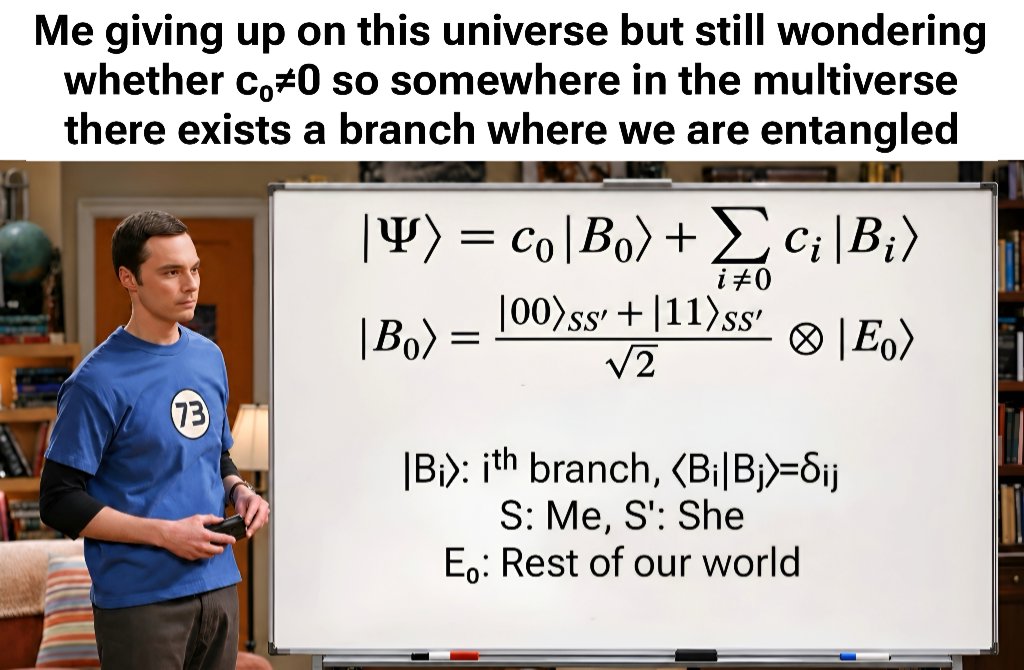
On the whiteboard, the universal state vector is expanded into mutually orthogonal branch states $\langle B_i | B_j \rangle = \delta_{ij}$ with $\sum_i |c_i|^2 = 1$:
$$\begin{aligned}|\Psi\rangle &= c_0|B_0\rangle + \sum_{i \neq 0} c_i|B_i\rangle, \\[4pt] |B_0\rangle &= \frac{|00\rangle_{SS'} + |11\rangle_{SS'}}{\sqrt{2}} \otimes |E_0\rangle.\end{aligned}$$In Hugh Everett's relative-state (Many-Worlds) formulation (
Everett 1957), global unitary evolution generates superpositions of quasi-classical branches $|B_i\rangle$. Inside the desired branch $|B_0\rangle$, subsystems $S$ ('Me') and $S'$ ('She') occupy the maximally entangled Bell state $|\Phi^+\rangle_{SS'} = (|00\rangle_{SS'} + |11\rangle_{SS'})/\sqrt{2}$ tensored with the rest-of-world state $|E_0\rangle$. Because $|\Phi^+\rangle_{SS'}$ is a pure bipartite state, monogamy of entanglement guarantees that $S$ and $S'$ are maximally entangled with each other and completely unentangled with the environment $E_0$ within that branch.
The physical qualification is **environmental decoherence** (
Zurek 2003). Warm macroscopic biological systems cannot remain isolated from their surrounding photon, phonon, and air-molecule bath $|E_0\rangle$: local interactions rapidly entangle $S$ and $S'$ with orthogonal environmental records $|E_{00}\rangle, |E_{11}\rangle$, turning the reduced state of $SS'$ within any macroscopic branch into a separable classical mixture rather than a coherent Bell state $|\Phi^+\rangle_{SS'} \otimes |E_0\rangle$. Furthermore, because $\langle B_0 | B_i \rangle = 0$ once macroscopic environmental states become orthogonal, observers in an $i \neq 0$ branch cannot access or interfere with branch $|B_0\rangle$ even if $c_0 \neq 0$.