An original collection of physics, quantum computing, mathematics, and epistemology memes, each paired with a rigorous technical explanation of the underlying theorem or physical mechanism.
Avid tactical chess player. Always happy to play a friendly rapid or blitz game with fellow researchers and students. I also upload short-form chess content, puzzles, and blitz tactics on YouTube.
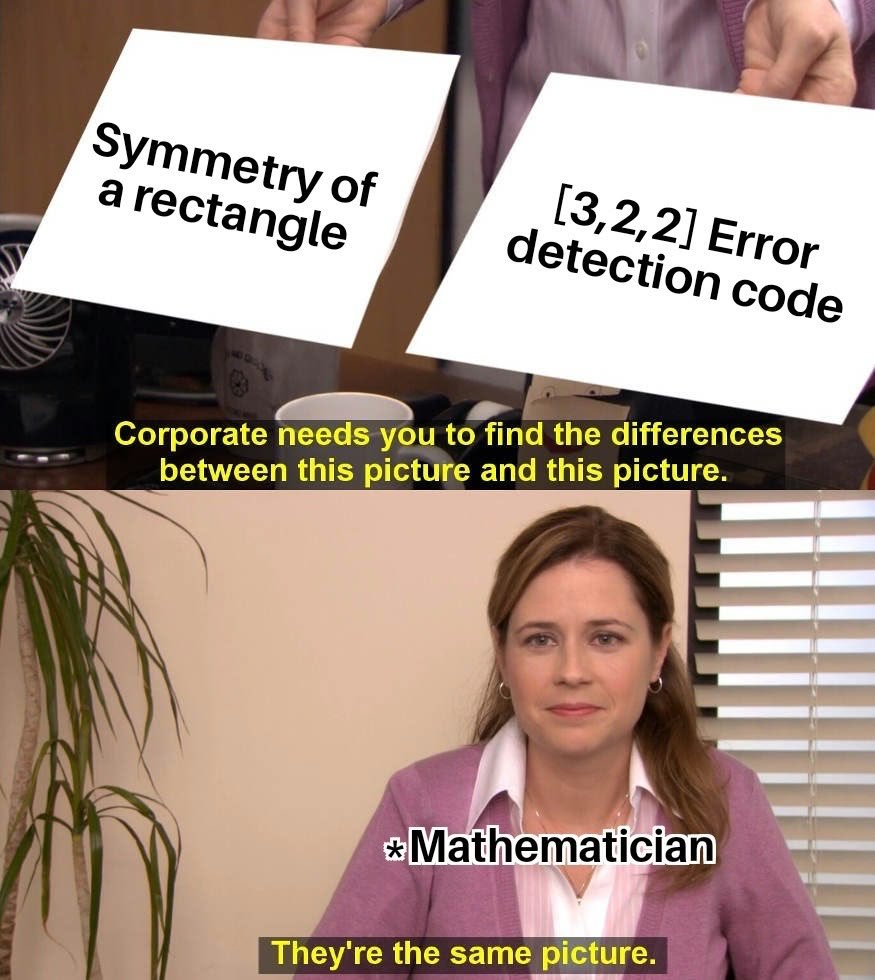
The joke identifies a shared algebraic structure. The symmetry group of a non-square rectangle has four planar isometries: identity $e$, horizontal reflection $h$, vertical reflection $v$, and a half-turn $r=h\circ v$. The reflections commute, and each non-identity element squares to $e$, giving the Klein four-group $V_4\cong\mathbb{Z}_2\times\mathbb{Z}_2$. The non-square condition matters: a square has eight planar symmetries. Now take the binary linear code $C=\{000,011,101,110\}$, the length-three even-parity code. Under bitwise addition modulo two (XOR), $C$ is also a group, and $011\oplus101=110$. The bijection $e\mapsto000$, $h\mapsto011$, $v\mapsto101$, $r\mapsto110$ respects the group operations. The notation $[3,2,2]$ records block length three, dimension two over $\mathbb{F}_2$, and minimum Hamming distance two. It detects every single-bit error but cannot in general correct an arbitrary single-bit error. This comparison concerns the additive group of codewords, not the code's coordinate-permutation automorphism group, which is $S_3$. The geometry, Hamming distance, and coding interpretation are additional structure, so the two objects are isomorphic as groups rather than literally identical in every respect. That is the precise sense in which the mathematician sees the same picture.