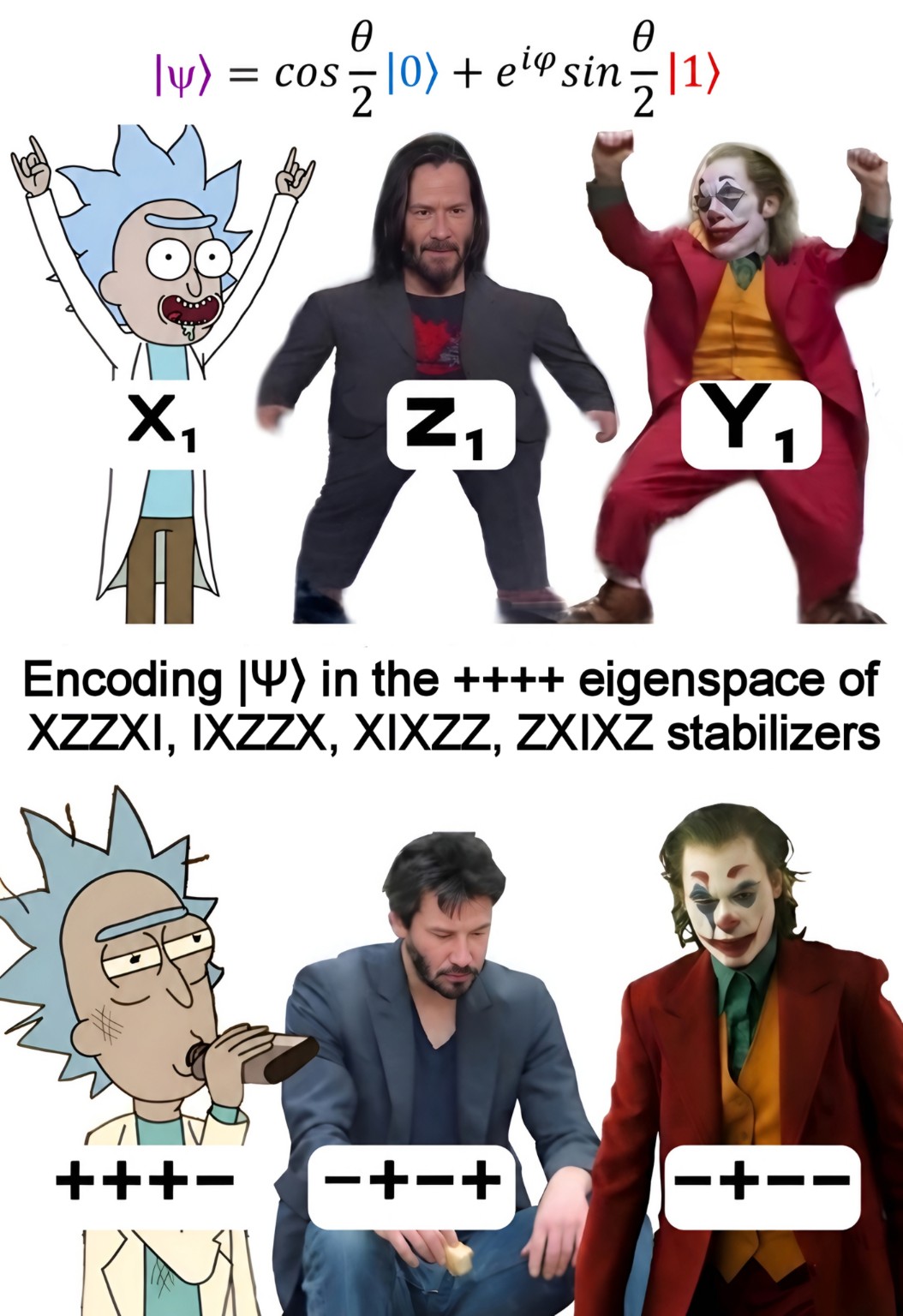
The $[[5,1,3]]$ perfect code stores one logical qubit in five physical qubits. Its stabilizer generators are $g_1 = XZZXI$, $g_2 = IXZZX$, $g_3 = XIXZZ$ and $g_4 = ZXIXZ$, with qubits numbered from left to right. The four generators commute and are independent, leaving a two-dimensional common $+1$ eigenspace. Every encoded state $\alpha|0_L\rangle + \beta|1_L\rangle$ therefore gives the check outcomes $++++$.
A Pauli error E flips a check's sign exactly when it anticommutes with that check. In the printed order $(g_1, g_2, g_3, g_4)$, $X_1$ gives $+++-$, $Z_1$ gives $-+-+$, and $Y_1$ gives $-+--$. The meme's troublemakers have become distinguishable by their syndromes, without revealing $\alpha$ or $\beta$. Applying the identified Pauli again undoes it.
All fifteen single-qubit Pauli errors have distinct nonzero syndromes. Together with no error, they use all sixteen outcomes: $2 \times (1 + 3 \times 5) = 32 = 2^5$. That exact packing makes the code “perfect.” General single-qubit noise is correctable because its operators expand in $I, X, Y$ and $Z$; arbitrary multiple-qubit noise is outside that guarantee. Encoding makes the errors detectable and correctable, not unable to act.
Follow the calculation from groups and quotients through error correction, Clifford gates and magic states in Group Theory for Quantum Computing.