An original collection of physics, quantum computing, mathematics, and epistemology memes, each paired with a rigorous technical explanation of the underlying theorem or physical mechanism.
Avid tactical chess player. Always happy to play a friendly rapid or blitz game with fellow researchers and students. I also upload short-form chess content, puzzles, and blitz tactics on YouTube.
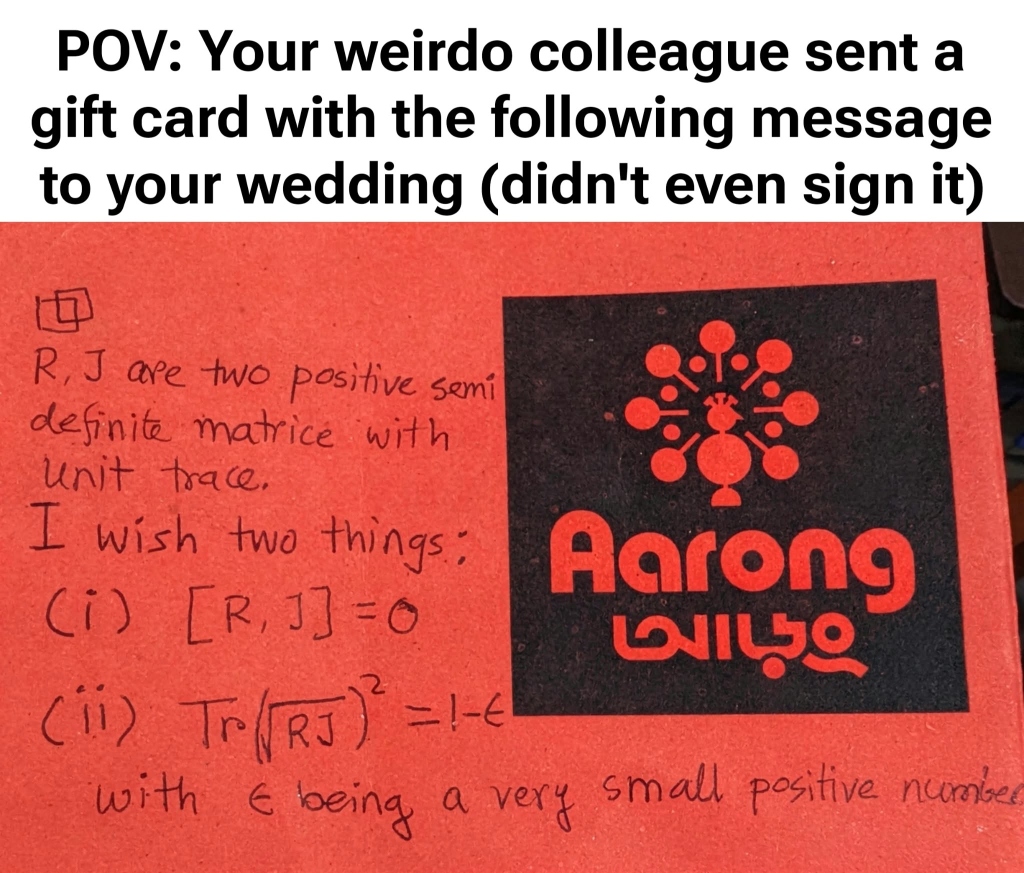
Fun fact: I was that “weirdo colleague” and actually handwrote and gifted this Aarong card at a colleague’s wedding! The newlyweds $R$ and $J$ are playfully represented by density matrices on the same Hilbert space: $R, J \succeq 0$ and $\operatorname{Tr}(R) = \operatorname{Tr}(J) = 1$. The wish $[R,J] = 0$ means they share an eigenbasis. A nonselective projective measurement in that common basis leaves either density matrix unchanged; it is not a claim about one partner’s measurement having no effect on another. The squared quantum fidelity is $F(R,J) = [\operatorname{Tr} \sqrt{\sqrt{R} J \sqrt{R}}]^2$. Because R and J commute, this becomes $[\operatorname{Tr} \sqrt{RJ}]^2$, exactly the card’s expression. Wishing $F = 1 - \varepsilon$ with tiny positive $\varepsilon$ asks for nearly matching states while retaining a sliver of distinguishability. Compatibility, closeness, and a little individuality: a very quantum wedding blessing.
Topics:quantum state fidelitycommuting density matricessimultaneous diagonalizationquantum information wedding wish